News analysis · Published
Google's Finland AI Investment: Why Power Terms Matter
By the ELYMENT AI editorial team · Free to read
Google announced on 9 September 2026 that it plans to invest at least €13 billion in Finnish digital and AI infrastructure during 2027 and 2028. The programme links new data centres to a 22-year nuclear power purchase agreement, contracted wind and battery capacity, and grid planning. The business lesson is broader than Google or Finland: usable AI capacity now depends on energy arrangements that can outlast technology cycles. Buyers should test delivery dates, firmness, price exposure, resilience, environmental evidence and exit rights before treating announced compute as dependable service.
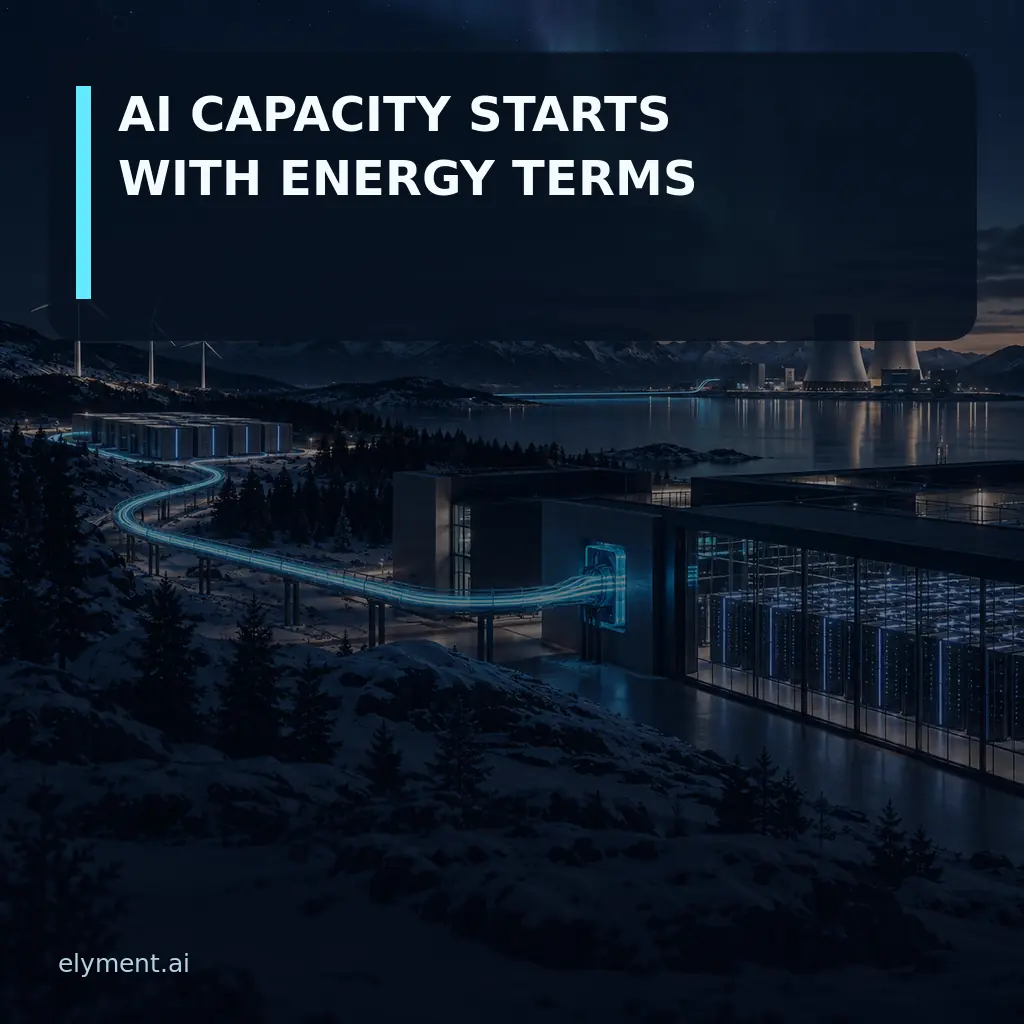
What Google announced in Finland
Google's 9 September announcement says it will invest at least €13 billion across 2027 and 2028 in data centres and supporting infrastructure in Hamina, Kajaani, Muhos and Vaala. Google described it as its largest single investment in Europe and said the facilities will support services including Gemini, Search, Maps and YouTube.
The energy package is unusually specific. Google disclosed a 22-year power purchase agreement with Fortum to support a life-extension programme at the Loviisa nuclear plant, additional wind agreements bringing its contracted new-to-grid onshore wind portfolio in Finland to 629 MW, and a 94 MW battery system expected to operate in late 2027. Reuters independently reported the investment and said the nuclear agreement covers up to half of the plant's energy output.
Why energy terms are now AI operating terms
AI infrastructure is not delivered by servers alone. It depends on physical sites, grid connections, firm electricity, cooling, networking and the ability to absorb or reduce load when the grid is stressed. Google's Finland plan makes those dependencies visible by pairing compute investment with generation, storage and location decisions.
For an enterprise buying AI through a cloud or managed service, the energy contract may be several suppliers away. The risk still reaches the buyer through capacity reservations, regional availability, price changes, service interruptions and sustainability claims. A provider's announced investment is therefore evidence of intent, not proof that a buyer's workload has power-backed capacity on the required date.
Do not confuse the energy portfolio with a service guarantee
The disclosed projects operate on different clocks. Google's investment programme is planned for 2027 and 2028, the battery is expected in late 2027, and the nuclear agreement supports plant operation beyond 2030. The Google sources do not publish customer-level capacity allocations, cloud service-level changes or a price commitment for AI buyers.
That distinction matters. Long-duration energy contracts can improve planning and support new investment, but workload continuity also depends on commissioning, transmission, backup, maintenance and contractual remedies. Business leaders should separate the provider's national energy narrative from the enforceable terms attached to their own region, service and workload.
Use a six-part energy-backed capacity check
Before relying on a new AI region, reserved cluster or managed service, document six controls:
- Delivery: record the commissioned service date, dependencies and evidence required before capacity is treated as available.
- Firmness: identify which supply is firm, interruptible or subject to curtailment, maintenance and grid constraints.
- Price: define energy and capacity pass-throughs, indexation, reservation charges and relief if delivery slips.
- Resilience: map backup power, network diversity, recovery objectives and the failure modes shared across sites.
- Evidence: require current metering, carbon-accounting boundaries and assurance for environmental claims used in reporting.
- Exit: test workload portability, data export, unused-capacity treatment and supplier substitution before committing long term.
What business leaders should do next
Ask cloud and infrastructure suppliers for an energy-backed capacity statement for each critical workload. It should name the service region, availability date, capacity class, power dependencies, price mechanism, recovery path and the evidence you will receive. Keep this beside the workload's technical acceptance test rather than inside a broad sustainability appendix.
ELYMENT AI's analyses of TCS HyperVault, Europe's LUMI-AI supercomputer and NVIDIA capacity planning extend the same discipline across commissioned capacity, workload readiness and cost per accepted outcome. ELYMENT AI can help turn the six checks into a concise supplier evidence register for a specific AI programme.
Sources
- Google Cloud: €13 billion Finland infrastructure investment (9 September 2026) - Primary announcement covering the investment period, locations, economic estimates, energy agreements, battery timing and community programmes.
- Google: Responsible clean energy growth in Finland (9 September 2026) - Primary technical explanation of site selection, the Loviisa life-extension agreement, 629 MW wind portfolio, 94 MW battery and grid-flexibility approach.
- Reuters: Google invests in Finnish AI infrastructure and nuclear power (9 September 2026) - Independent reporting on the €13 billion plan, three northern data centres, the 22-year nuclear agreement and Fortum's stated role.
- The Wall Street Journal: Google's Finland investment and power agreement (9 September 2026) - Independent reporting on the four locations, European investment context, wind agreements, battery system and Loviisa power purchase terms.
Continue learning
Frequently asked questions
How much is Google investing in Finland's AI infrastructure?
Google announced at least €13 billion for digital and AI infrastructure in Finland during 2027 and 2028.
What energy projects are linked to Google's Finland expansion?
Google disclosed a 22-year Fortum nuclear power agreement, wind contracts taking its new-to-grid Finnish portfolio to 629 MW, and a contracted 94 MW battery system expected in late 2027.
Does the investment guarantee AI capacity for business customers?
No customer-level guarantee was published. Buyers still need contractual evidence for regional availability, delivery, price, resilience, environmental reporting and exit.