News analysis · Published
Intel's Agentic AI Hardware Stack: What Businesses Should Run Where
By the ELYMENT AI editorial team · Free to read
Intel used Hot Chips 2026 on 24 August to detail three architectures for agentic AI: Diamond Rapids for orchestration and enterprise compute, Crescent Island for inference, and Wildcat Lake for client and edge systems. The announcement is a useful placement map, not an independent performance verdict. Businesses should decide where each workload belongs before selecting hardware, using data sensitivity, latency, concurrency, model size, power and portability as the governing criteria.
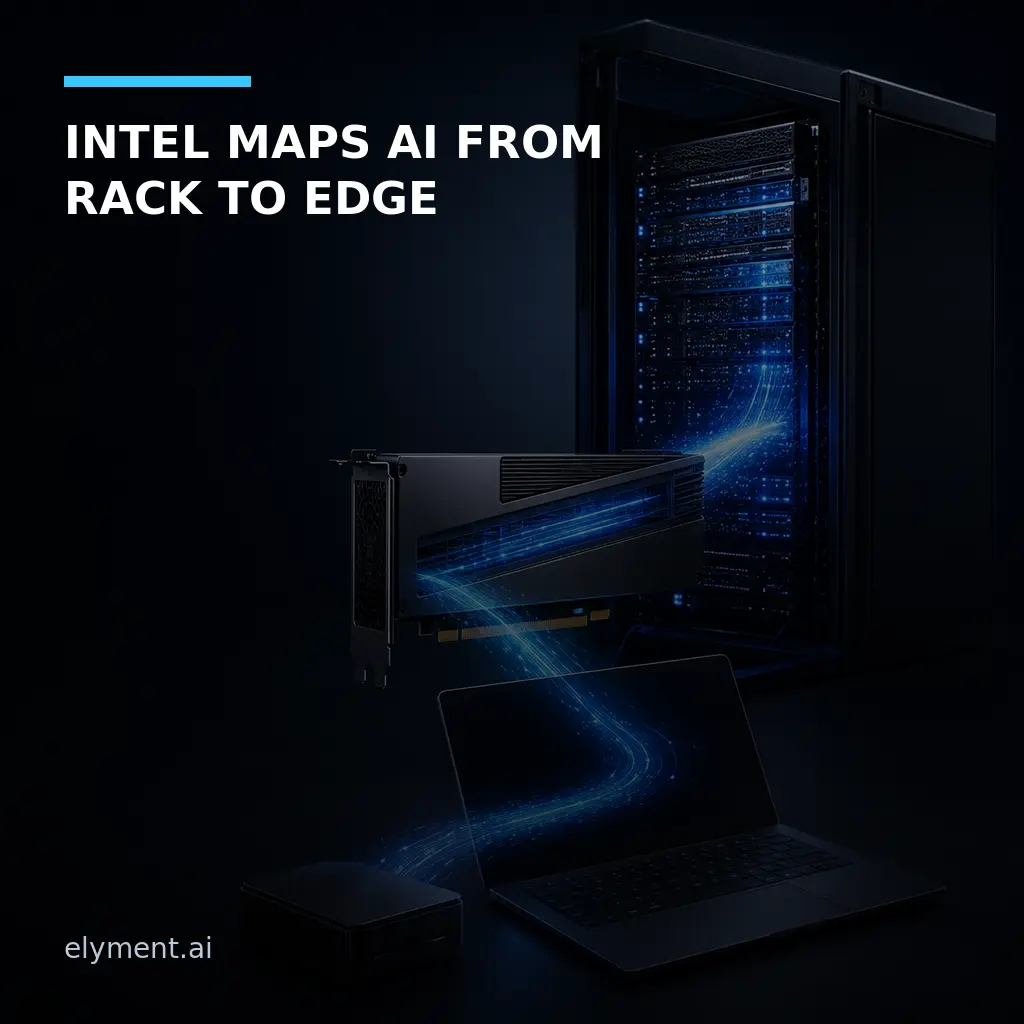
What Intel disclosed at Hot Chips 2026
Intel described a rack-to-edge architecture rather than a single AI product. Diamond Rapids, its future Xeon 7+ server processor, is positioned for orchestration and enterprise compute. Intel says it will scale to 256 cores, provide 16 memory channels at 12,800 MT/s, and expose 128 PCIe Gen6 lanes with CXL 3.0. Those figures are vendor specifications disclosed on 24 August 2026, not independently verified workload results.
Crescent Island is an inference-focused data-centre GPU with 32 Xe cores, 256 XMX engines and up to 480GB of LPDDR5X memory. Intel says the 350-watt PCIe card will use air cooling. Wildcat Lake, branded Intel Core Series 3, brings a six-core CPU and an NPU rated at up to 17 TOPS to entry-level client and edge systems. Intel did not publish pricing in the announcement.
Why agentic AI needs more than one compute tier
An AI agent can plan a task, call tools, retrieve data, run several model requests and ask for human approval before it completes one business outcome. That creates different compute jobs. Central orchestration benefits from memory capacity, connectivity and predictable concurrency. Repeated model inference may favour a dedicated accelerator. Low-latency actions involving local sensors or sensitive data may need to run on a client or edge device.
Tom's Hardware Italia characterised Intel's message similarly: no single class of hardware is expected to serve every agentic AI workload. The practical point is broader than Intel. A company that sends every task to its largest cloud model may buy unnecessary latency and cost, while pushing every task to the edge can constrain model capability, observability and update control.
Decide workload placement before choosing hardware
Start with the business transaction, then decompose it. A customer-service agent, for example, may keep policy retrieval and approval logging in a governed data centre, route complex reasoning to an accelerator-backed model service, and run voice capture or document redaction locally. The architecture should follow the control boundary and service target, not the newest processor label.
Crescent Island's stated 350-watt air-cooled PCIe format may be attractive to operators that cannot support liquid cooling, according to independent coverage. It still needs testing against the actual model, context length, batching pattern and reliability target. Memory capacity alone does not prove throughput, quality or cost per accepted task.
A five-part workload placement test
Before approving an agentic AI infrastructure purchase, score each workload against the same five questions:
- Data: what information may leave the device, site, region or security boundary?
- Latency: how quickly must the user, machine or workflow receive a reliable answer?
- Scale: how many concurrent agents, model calls and tool actions must the system sustain?
- Operations: what power, cooling, networking, monitoring and failover can the environment support?
- Portability: can the workload move between cloud, data centre and edge without rebuilding its evaluations and controls?
What business leaders should do next
Treat Intel's architecture disclosure as a prompt to build a workload map. Measure accepted-task cost, not processor utilisation alone. Run the same governed evaluation across at least two placement options, include network and human-review delays, and price the migration path before committing to a platform.
ELYMENT AI's analysis of NVIDIA server pricing shows why infrastructure budgets need component-level scenarios. The AI compute derivatives guide explains the emerging market for capacity risk, while the Brazil sovereign compute analysis covers multi-vendor resilience. Together, they reinforce one decision rule: place each AI workload where its data, service level and operating economics can be proven.
Sources
- Intel Newsroom - architectures for agentic AI at Hot Chips 2026 (2026-08-24) - Primary disclosure of Diamond Rapids, Crescent Island and Wildcat Lake specifications and Intel's rack-to-edge positioning.
- Tom's Hardware Italia - Intel's three agentic AI architectures (2026-08-24) - Independent coverage of Intel's Hot Chips disclosures and the role of different hardware tiers in agentic AI.
- Hardwareluxx - Crescent Island architecture (2026-08-24) - Independent technical coverage of Crescent Island's memory, power, cooling and PCIe form-factor claims.
Continue learning
Frequently asked questions
What did Intel announce for agentic AI at Hot Chips 2026?
Intel detailed Diamond Rapids for orchestration and enterprise compute, Crescent Island for data-centre inference, and Wildcat Lake for client and edge systems.
Do Intel's specifications prove the best business performance?
No. The figures are vendor specifications, and the reviewed sources do not provide independent application benchmarks or pricing. Buyers should test their own models and service targets.
How should a business place an agentic AI workload?
Use data sensitivity, latency, concurrency, model size, power and cooling, observability, accepted-task cost and portability to compare cloud, data-centre and edge options.