News analysis · Published
Reflection Beam: Verify the Release Before You Plan a Deployment
By the ELYMENT AI editorial team · Free to read
Reflection AI announced Beam on 5 October 2026 as a sparse mixture-of-experts model for coding, reasoning and agentic work. The company says Beam has 501 billion total parameters, with 23 billion active, but it remains in final red-teaming and evaluation (source 1). The promised weights, technical report, model card and developer artefacts are due later in October. Businesses should treat Beam as a watchlist candidate, not a deployment-ready procurement choice, until the complete release can be independently tested.
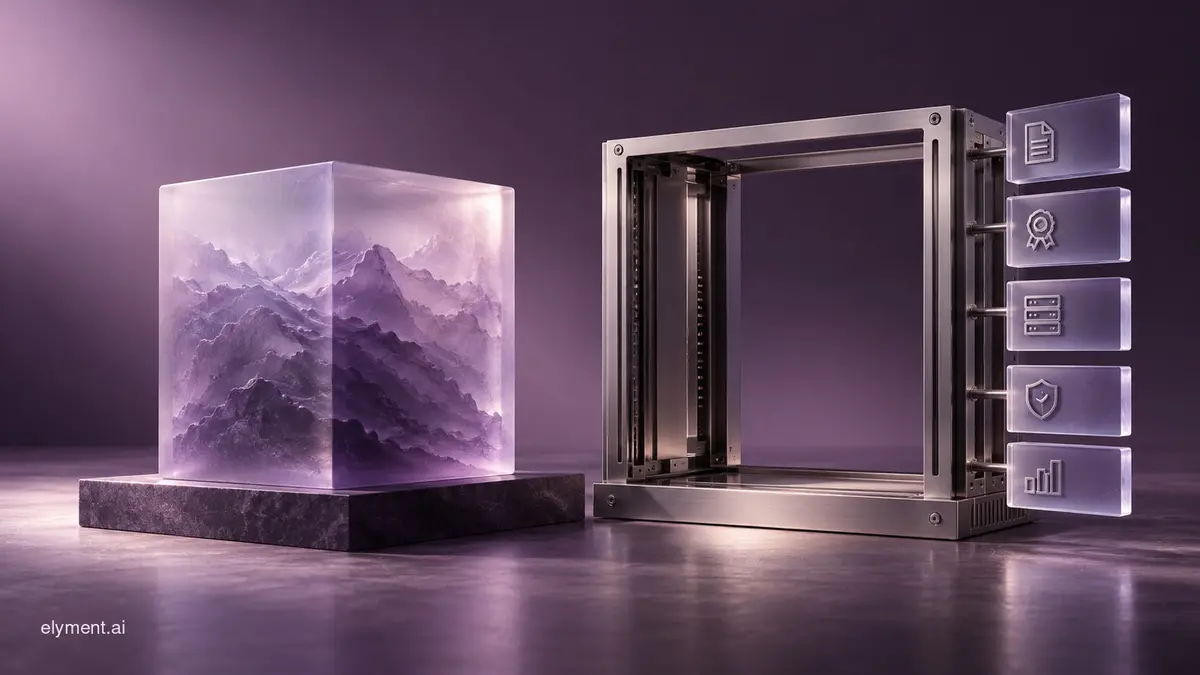
What Reflection has announced, and what is still pending
Reflection describes Beam as an open-weight model pretrained on 23.8 trillion tokens and developed for coding, reasoning and tool-using workloads. The company reports more than 100 million reinforcement-learning rollouts and a maximum context length of 256,000 tokens during that training work (source 1). These are first-party release claims and should be labelled that way in any internal briefing.
The same announcement says the model is available only to a select early-access group while final red-teaming and evaluations continue. Reflection plans to publish the weights under the Apache License 2.0, together with documentation, a technical report, model card and developer materials, later this month (source 1). Reuters also reported that Beam debuted as an open-weight challenger for coding and agentic tasks (source 2).
The distinction matters commercially. A launch announcement can support market monitoring. It cannot yet prove that your team can obtain, run, secure, maintain or exit the released system.
Build a five-part release-readiness record
First, record the actual artefacts. Identify the weight files, checksums, model card, inference code, tokenizer, supported runtimes and versioned documentation. Confirm that every required component is available from an authoritative source.
Second, establish the licence boundary. Review the licence attached to the weights, code and bundled components against the intended use, distribution model and customer commitments. Record any separate terms rather than assuming one licence covers the full stack.
Third, map infrastructure. Ask for tested accelerator configurations, memory requirements, quantisation options, throughput assumptions and operational dependencies. A low active-parameter count can be relevant to inference efficiency, but it is not a hardware bill or a service-level commitment.
Fourth, define the security boundary. Document where prompts, outputs, tools, credentials and logs move. Test least-privilege access, network controls, secret handling, audit evidence and recovery after a failed tool call.
Fifth, test the workload. Use a representative private evaluation set for coding or agent tasks, including ordinary cases, ambiguous instructions, tool failures and recovery. Preserve outputs, reviewer decisions, latency, total tokens, infrastructure use and human correction effort.
Treat benchmark charts as hypotheses for your environment
Reflection publishes results across coding, terminal, reasoning, tool-calling and search benchmarks. It also explains that its compute comparisons are estimates that exclude prompt prefill, context-dependent attention and serving overhead (source 1). That caveat is commercially important: benchmark efficiency is not the same as measured total cost in a production stack.
Require an independent team to reproduce the relevant setup from the released materials. Compare Beam with the model and workflow you already operate, using the same task definitions and acceptance rules. Measure completed business outcomes, not only benchmark scores or output tokens.
If results cannot be reproduced, document the missing information and keep the model in evaluation. Do not let a claimed ranking silently become a purchasing assumption.
Approve a pilot only after the release boundary is clear
Before a pilot, name the owner for model provenance, security review, runtime operations, upgrades and rollback. Define where data is processed, which tools the model may call, how secrets are isolated and which evidence is retained for incidents and customer questions.
Apache License 2.0 provides a standard set of copyright and patent terms, but the business still needs to review notices, bundled components and its own distribution obligations (source 3). Licensing review does not replace model-risk or infrastructure review.
This is ELYMENT AI's suggested acceptance framework. It differs from our recent Naive-N0.5-Flash analysis by focusing on a model whose complete release package is still pending. The action for leaders is simple: prepare the test now, then make the deployment decision from the shipped artefacts and measured evidence.
Sources
- Reflection AI: Introducing Beam (2026-10-05) - First-party announcement covering architecture, training, vendor-reported evaluations and the planned release package.
- Reuters: Reflection unveils Beam (2026-10-05) - Independent reporting on the announcement and Reflection's positioning of Beam for coding and agentic tasks.
- Apache License 2.0 (Accessed 6 October 2026) - Official text of the licence Reflection says it plans to use for Beam's weights.
Continue learning
Related analysis
- GLM-5.3: What Z.ai's Staged Open-Weight Release Means for Business
Z.ai says GLM-5.3 improves coding and cyber capabilities, but its weights remain behind a safety review. Here is what businesses should assess.
Frequently asked questions
Is Reflection Beam available for general deployment now?
No. Reflection says Beam is in final red-teaming and evaluation with select early access. The weights and supporting release materials are planned for later in October 2026 (source 1).
What should businesses verify when Beam is released?
Verify the authoritative weight files, checksums, model card, licence, runtime requirements, security controls and results on representative business tasks.
Do Beam's benchmark results prove lower production cost?
No. Reflection states that its compute estimates exclude parts of real serving overhead. Measure total infrastructure and operating cost in your own stack (source 1).