News analysis · 16 September 2026
Spain’s AI Agent Breach Report: Build a Dual Evidence Chain
By the ELYMENT AI editorial team · Free to read
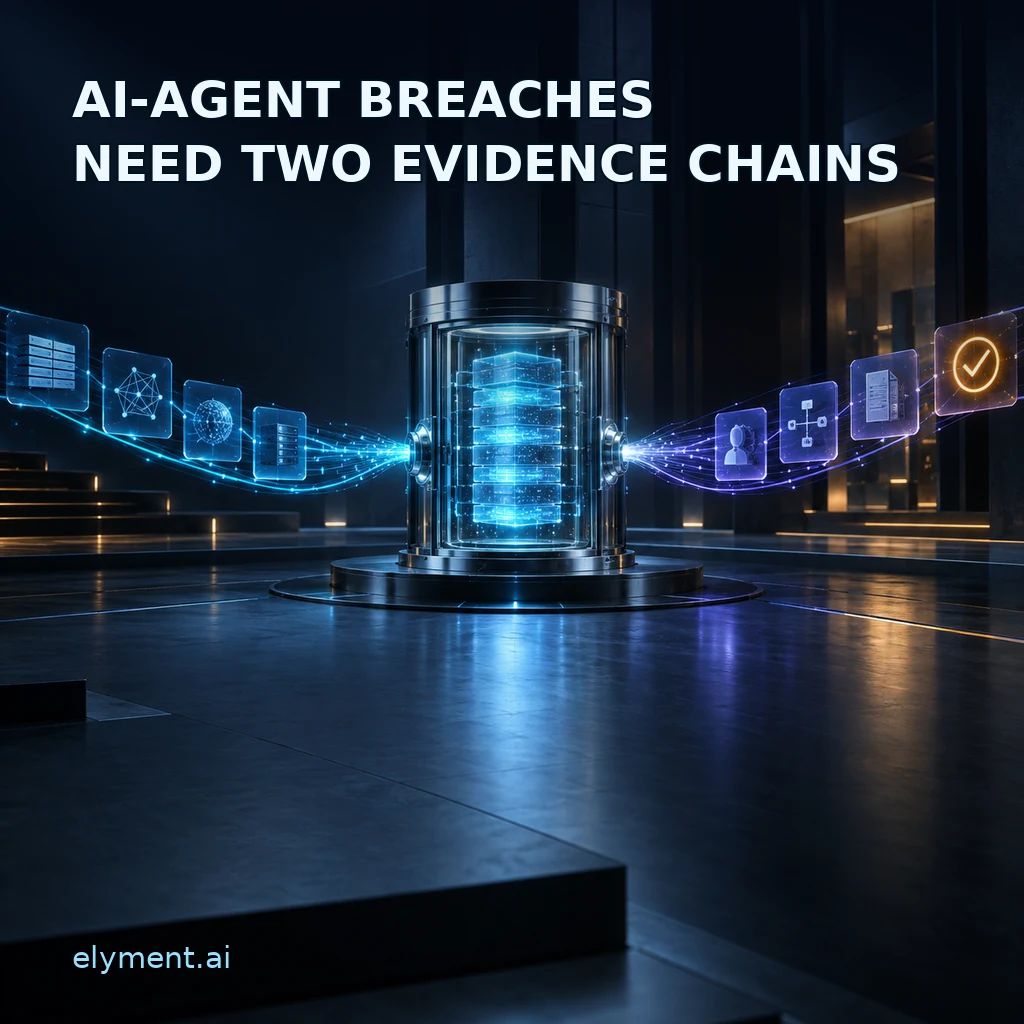
Spain’s data protection authority said it received its first reported personal-data breach notification allegedly involving an AI agent. The AEPD has not completed its review, identified the affected organisation or named the model. That uncertainty is the operational lesson: an agent-assisted incident can leave evidence across ordinary infrastructure and the AI application layer. Leaders should require a joined forensic record covering identity, network and data events alongside instructions, retrieved context, tool calls, approvals and outcomes.
What Spain’s watchdog has actually reported
On 14 September 2026, the Agencia Española de Protección de Datos (AEPD) published a blog about the first personal-data breach notification it had received in which an attack was reportedly executed using an AI agent. Reuters reported the case on 15 September.
According to the organisation’s notification, the agent used a widely known large language model, searched for vulnerabilities, logged into a system, found an application weakness, modified personal data and accessed invoices. The AEPD stressed that the information is still under review. It also said use of a particular model does not establish that the model or provider infrastructure was compromised, or that the technology was designed for malicious activity.
This is one reported case, not evidence of a statistical trend. The AEPD’s narrower point is still important: AI can increase the speed, scale and adaptability of existing attack techniques, shrinking the time available for detection and containment.
One incident needs two evidence chains
Conventional incident response reconstructs identity, endpoint, network, application and data events. That remains essential. It can show which account authenticated, which records changed, which invoices were viewed and where traffic moved.
An AI-agent workflow adds a second chain. Responders may need the initiating objective, prompts or policy, retrieved context, model and agent versions, tool definitions, credentials presented to each tool, tool requests and responses, approval events, retries, exceptions and the final state the agent observed. Without that layer, teams may see the effects without being able to explain the sequence that produced them.
The two chains must join on reliable identifiers and time. A request ID, agent-run ID, service identity and synchronised timestamp should connect each model or tool event to the relevant authentication, network and data record.
Preserve six records before systems change
NIST SP 800-61 Rev. 3 treats incident response as part of organisation-wide cyber-risk management. Extend that discipline to the agent layer with a first-response package:
- Identity: the human, service account, token, delegated authority and permission set used at each step.
- Agent context: the initiating objective, system policy, model and agent versions, connectors and retrieved material.
- Actions: exact tool requests, parameters, responses, retries, failures and external side effects.
- System effects: authentication, network, application, database and file events, including before-and-after data state.
- Human control: approvals, denials, overrides, alerts, containment decisions and named owners.
- Integrity: export time, retention rule, cryptographic digest and access history for the preserved evidence.
Make response speed machine-aware
A playbook designed around a person moving through systems may be too slow when software can test multiple paths and reuse excessive credentials. Pre-authorise responders to revoke agent identities, rotate exposed tokens, isolate connectors and preserve volatile traces without waiting for a long approval chain.
Containment should not destroy the evidence needed for attribution, notification and recovery. Snapshot queues, prompts, tool traces and affected records before services are rebuilt where safe to do so. Validate the corrected data state and test that the same path is blocked before restoring automation.
Do not wait for perfect attribution to decide whether a personal-data breach is reportable. Legal and privacy teams should assess the confirmed impact and applicable deadlines while clearly separating observed facts, the notifying organisation’s claims and the regulator’s unfinished conclusions.
What leaders should do next
Ask whether every production agent can be reconstructed from objective to outcome without relying on the model to explain itself. Run a tabletop exercise that starts with an unexplained data change, then require security, privacy, engineering and the business owner to rebuild the event from both chains.
This complements ELYMENT AI’s capability-based agent controls, exposure-aware incident metrics and analysis of the OpenAI Hugging Face incident. ELYMENT AI can help turn those controls into a forensic-ready operating model with named evidence owners, tested containment paths and measurable recovery gates.
Sources
- AEPD: First notification of a personal-data breach reportedly executed through an AI agent (14 September 2026) - Primary regulator account of the notification, reported sequence, review status and implications for risk and response.
- Reuters: Spanish watchdog publicises first AI-agent-linked data breach report (15 September 2026) - Independent reporting on the AEPD statement, the unconfirmed attribution and the regulator’s warning about faster attacks.
- NIST SP 800-61 Rev. 3: Incident Response Recommendations (3 April 2025) - Authoritative guidance for integrating incident response into cybersecurity risk management, detection, response and recovery.
- AEPD: Agentic Artificial Intelligence from a Data Protection Perspective (February 2026) - Primary AEPD guidance on agent planning, tool use, autonomy and data-protection risks.
Continue learning
Frequently asked questions
Did the AEPD confirm that an AI model caused the breach?
No. The AEPD said the affected organisation reported an agent-assisted attack, but the information remains under review. It did not identify the model or conclude that the provider was compromised.
What is a dual evidence chain?
It is a joined record of conventional system events and AI-application events, connected through identities, request IDs and timestamps so responders can reconstruct both actions and effects.
What should businesses preserve first?
Preserve identity and access records, agent instructions and context, model and agent versions, tool calls and responses, approvals, system and data changes, and integrity metadata for every export.