News analysis · Published
AI Is Rewriting IT Services Contracts: What Businesses Should Negotiate
By the ELYMENT AI editorial team · Free to read
AI is accelerating a shift in IT services pricing from billable hours towards measurable business outcomes. Reuters reported on 21 August 2026 that major Indian providers are restructuring contracts as clients demand faster delivery and lower costs. For buyers, the opportunity is not a blanket AI discount. It is a better commercial model that defines the baseline, accepted result, quality threshold, shared dependencies and cost risks before automation begins.
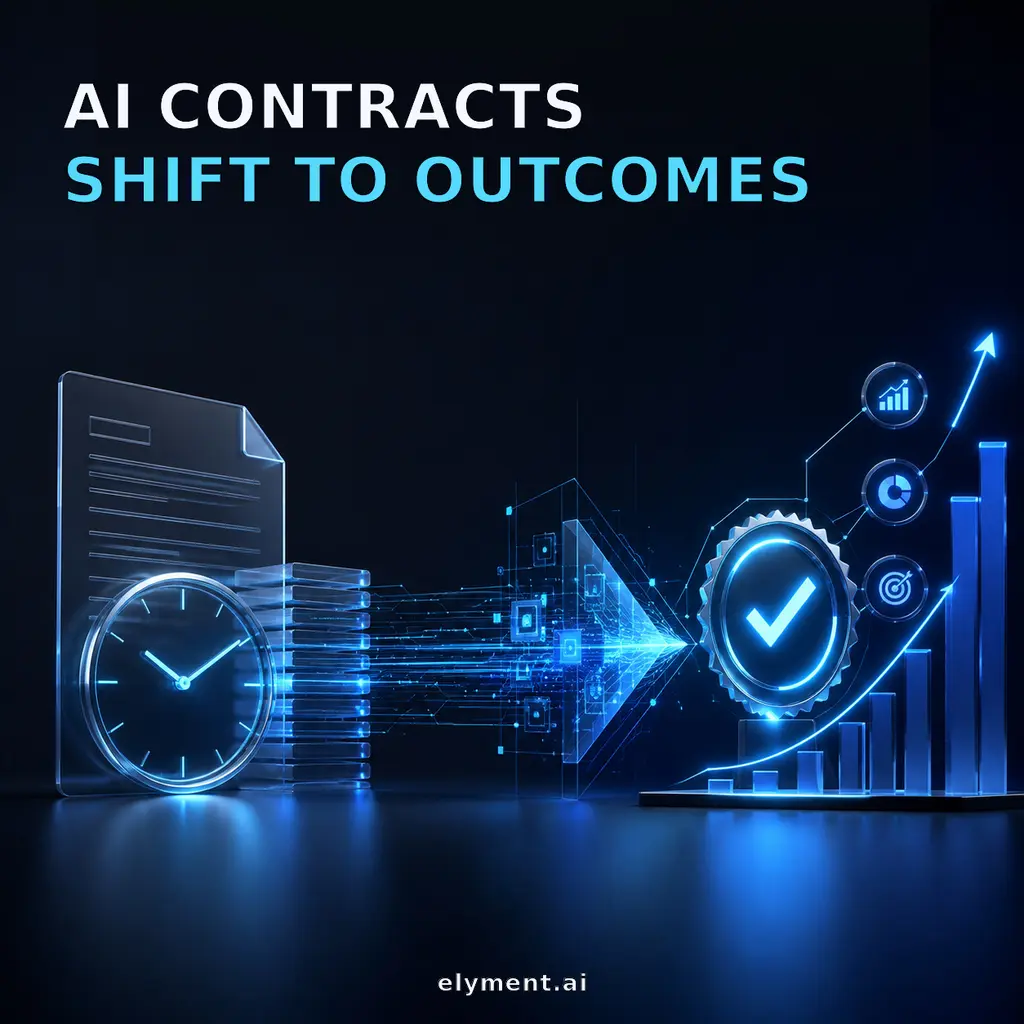
Why the billable-hour model is losing leverage
The traditional outsourcing model rewards the volume of people and time assigned to a job. AI coding, testing and process automation weaken that link because a smaller team may complete the same work faster. Reuters reported that India's IT services industry, which generates about US$315 billion in annual revenue, is increasingly tying fees to performance outcomes rather than hours worked.
Tata Consultancy Services chief executive K Krithivasan told Reuters that about 80 per cent of the company's contracts across finance, human resources and other business services now use outcome-performance measures. That is a significant signal from a major provider, but it does not mean every IT contract or every type of work is ready for outcome pricing.
Outcome pricing changes who carries the risk
Under time-and-materials pricing, the buyer generally carries more delivery-efficiency risk because more effort can mean a larger invoice. An outcome-based agreement can transfer some of that risk to the provider, but only when both parties can define and measure the result fairly.
Cognizant's official February announcement confirms a multi-year AI and automation workplace-services programme for Daimler Truck. Reuters, citing people familiar with its terms, reported that AI-related savings would be shared between provider and client. HCLTech separately confirmed a multi-year cloud and network partnership with E.ON using automation and AI; Reuters reported, again citing people familiar with the agreement, that later payments were linked to efficiency and business outcomes. The public announcements confirm the programmes, while the private pricing details remain reported rather than company-confirmed.
Lower price is not the same as better value
Persistent Systems chief executive Sandeep Kalra told Reuters that clients were asking for the same work at prices 25 to 30 per cent lower, with faster delivery and higher productivity. That figure describes current demands reported by one provider, not a universal benchmark businesses should apply to every supplier.
Aggressive guarantees can also hide fragile assumptions. Tech Mahindra chief executive Mohit Joshi said some competitors were pricing in productivity gains of 70 to 80 per cent over five to seven years despite rising chip costs. A contract that looks inexpensive can fail if the baseline is unclear, quality declines, data is unavailable or model and compute costs move unexpectedly.
Seven clauses to negotiate before signing
A useful outcome contract makes the operating model testable, not merely optimistic. Procurement, technology and business owners should agree on:
- Baseline: the current cost, cycle time, volume and quality against which improvement will be measured.
- Accepted outcome: the exact deliverable, service level and evidence required for acceptance.
- Quality and rework: error tolerances, human-review requirements and who pays when work must be corrected.
- Dependencies: the data, access, staff decisions and change windows each party must provide.
- AI cost assumptions: how model, token, compute and third-party price changes affect fees.
- Governance: audit logs, security controls, incident handling and human approval for consequential actions.
- Change and exit: a process for scope changes, model substitution, portability and termination assistance.
What business leaders should do next
Start with one bounded service where the result can be observed, such as resolved support requests, accepted software changes or correctly processed documents. Run a parallel baseline, agree on quality before savings and review exceptions rather than relying on an average productivity claim.
ELYMENT AI's practical guides to [writing an AI work brief](/insights/ai-agent-work-brief-template), [measuring compute cost per accepted outcome](/insights/ai-compute-derivatives-cftc-business-impact) and [setting human approval gates](/insights/ai-agent-approval-workflow-businesses) can help teams define the work before renegotiating the commercial model. AI makes outcome pricing more feasible, but disciplined measurement is what makes it fair.
Sources
- Reuters: AI reshapes India's IT services contracts (21 August 2026) - Independent reporting on the move from billable hours to outcome-based pricing, client cost demands and provider risk.
- Cognizant: AI-driven workplace services transformation (24 February 2026) - Official announcement confirming the multi-year AI and automation workplace-services programme for Daimler Truck.
- HCLTech: E.ON cloud and product transformation partnership (16 June 2025) - Official announcement confirming the multi-year E.ON partnership and its use of automation and AI to improve efficiency.
Continue learning
Frequently asked questions
What is an AI outcome-based IT services contract?
It links some or all supplier fees to defined results, such as accepted software changes, resolved cases, service levels or efficiency gains, rather than only hours or headcount.
Should AI make an IT services contract 25 to 30 per cent cheaper?
Not automatically. Reuters reported that clients were making those demands of Persistent Systems, but the appropriate price depends on the baseline, scope, quality, risk, data and technology costs.
What should a business measure in an outcome contract?
Measure accepted completion, quality, cycle time, rework, service levels, compliance and total cost. Hours and token usage may explain cost, but they are not the business outcome.