News analysis · Published
Anthropic’s Claude Enzyme Discovery: Build a Scientific Evidence Chain
By the ELYMENT AI editorial team · Free to read
Anthropic said on 23 September 2026 that Claude helped identify a previously uncharacterised enzyme system, array-associated reverse transcriptases, or ART, in bacteriophage DNA. The result is an important demonstration of AI-assisted hypothesis generation, but not yet a proven biotechnology platform. Anthropic says ART’s biological function remains unknown and further experiments are underway. R&D leaders should therefore preserve a scientific evidence chain from search prompt and source data through novelty review, wet-lab results, replication, safety and commercial acceptance.
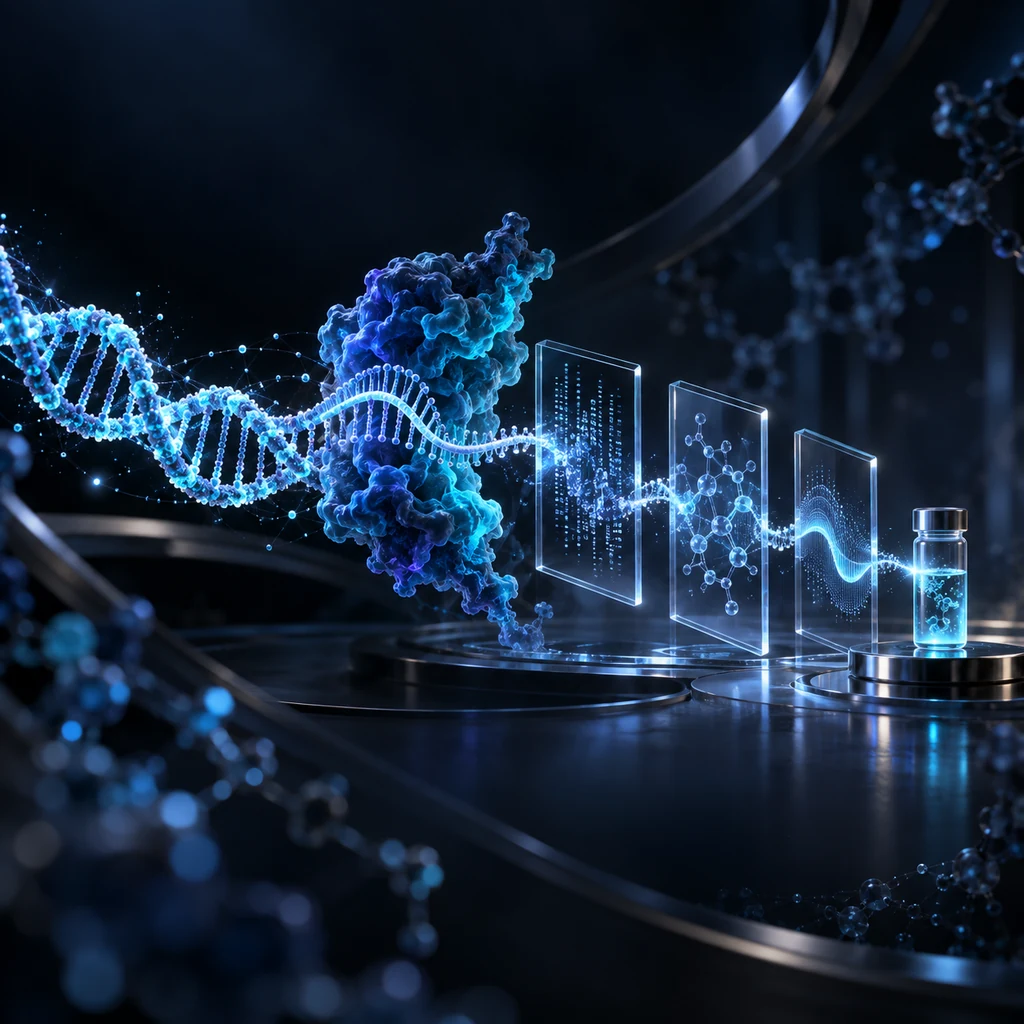
What Claude found in the DNA data
Anthropic’s new life sciences research group asked Claude to search a large DNA sequence database for unusual reverse transcriptases, enzymes that copy RNA into DNA. The company says roughly 950 agents ran for 21 hours and used 210 million tokens. They gathered more than 200,000 reverse transcriptases, identified 3,500 candidate systems and narrowed the field to 20 reports for human review.
One agent noticed repeating DNA beside an unusual reverse transcriptase. Anthropic’s scientists then analysed and tested the candidate in their laboratory. They named the three-part system array-associated reverse transcriptases: an RT, a neighbouring partner gene and a long array of evenly spaced repeats. The company reports that the array produces distinct short RNAs, a property reminiscent of programmable systems such as CRISPR. The underlying RT had appeared in earlier studies; Anthropic says Claude was first to connect it with the repeat array and accessory protein.
Reuters independently reported the announcement on 23 September. Both Reuters and Anthropic make the critical qualification clear: ART’s function is still being investigated. Similarity to CRISPR-like organisation is evidence for further study, not proof of gene-editing capability or clinical value.
Why an AI discovery claim needs layers
The immediate business value is not that an AI system has replaced scientists. It is that agents can screen a broad search space, document candidate reasoning and help experts choose which costly experiments deserve attention. Anthropic says humans supplied the high-level prompt and performed all laboratory work in biosafety level 1 and 2 facilities.
That division of labour also defines the risk. An agent can surface a statistically unusual pattern without establishing novelty, mechanism, reproducibility, safety or utility. A compelling report can make early evidence feel more mature than it is. Companies should keep each claim attached to its evidence level and prohibit commercial, intellectual-property or product decisions from jumping ahead of validation.
Build a scientific evidence chain
For every AI-generated research lead, maintain one traceable record from computation to accepted result:
Assign an accountable scientist at each transition. A hypothesis may move quickly, but it should not inherit a stronger label until the next evidence gate passes.
- record the research question, prompt, model and agent configuration, source databases, versions, exclusions and search date;
- preserve candidate-ranking criteria, discarded alternatives, uncertainty and the exact evidence supporting the selected lead;
- complete a documented literature and prior-art review before claiming novelty;
- predefine wet-lab controls, endpoints and failure criteria, then retain protocols, raw data and deviations;
- repeat the result across runs, operators and relevant conditions, followed by independent replication where the consequence warrants it;
- separate observed facts from proposed mechanism, potential application and commercial forecast; and
- require biosafety, intellectual-property, regulatory and product approval before expanding scope or making external claims.
What R&D leaders should do next
Start with a research programme where search breadth is the bottleneck and experiments can deliver clear, bounded feedback. Give agents read-only access first, log every source and require a human scientist to approve candidate selection and every physical experiment. Measure useful leads, experimental confirmation rate, cost per validated result and time to rejection, not the number of generated hypotheses.
This development is distinct from model benchmarking or simulated research. ELYMENT AI’s earlier analysis of Faraday examined company-run replication in mathematics, while the Gelomics article focused on standardised biological samples beneath predictive models. ART adds a new operational lesson: when AI originates the lead, provenance and validation must travel with it from the first database search.
ELYMENT AI helps organisations design that chain across data, agents, human approvals and outcome evidence. AI can widen the discovery funnel. Scientific and commercial acceptance should remain earned, stage by stage.
Sources
- Anthropic, Claude discovers a novel enzyme system with CRISPR-like repeats (23 September 2026) - Primary announcement for the research workflow, agent scale, candidate funnel, laboratory role, ART observations, limitations and biosafety scope.
- Anthropic, Array-associated reverse transcriptases technical report (23 September 2026) - Primary preprint describing the computational search, candidate analysis and initial experimental characterisation.
- Reuters, Anthropic says Claude AI helped discover novel enzyme system (23 September 2026) - Independent reporting on Anthropic’s announcement, the human and AI roles, ART’s proposed significance and unresolved function.
Continue learning
Frequently asked questions
What did Claude discover?
Anthropic says Claude identified array-associated reverse transcriptases, a previously uncharacterised three-part enzyme system found mainly in bacteriophages and associated with repeating DNA sequences.
Is ART a new CRISPR gene-editing tool?
No such capability has been established. Anthropic says ART has CRISPR-like repeat organisation, but its biological function remains unknown and experiments are continuing.
What should businesses require from AI-assisted research?
Require traceable source data, model and prompt records, novelty review, predefined experiments, raw results, replication, uncertainty labels and accountable safety, IP and commercial approvals.