News analysis · Published
Gelomics and Google Australia: Why AI Drug Discovery Needs Biological Proof
By the ELYMENT AI editorial team · Free to read
Google Australia announced on 4 September 2026 that Brisbane biotech Gelomics is combining reproducible 3D human tissue models with cloud and AI to improve early-stage cancer drug development. The plan links patient-derived tumour biology, molecular mapping, laboratory drug responses and clinical outcomes, with a prototype targeted for mid-2027. For business leaders, the important lesson is broader than biotech: prediction quality depends on a controlled evidence layer, and every AI result still needs experimental validation before it can guide consequential decisions.
What Gelomics and Google Australia announced
The partnership builds on Gelomics' participation in Google's AI First Accelerator Program. Google Australia says Gelomics will use cloud infrastructure and the Gemini Enterprise Agent Platform to optimise tissue-culture conditions, analyse complex cell data and train models that connect molecular tumour maps with drug responses and clinical outcomes.
Gelomics' immediate target is not bedside treatment selection. The company aims to release a prototype for early-stage drug development in mid-2027, while any use for individual hospital patients remains a longer-term goal requiring clinical validation. That distinction matters: this is a research and trial-design platform in development, not a clinically proven diagnostic or treatment system.
The real asset is a reproducible biological data layer
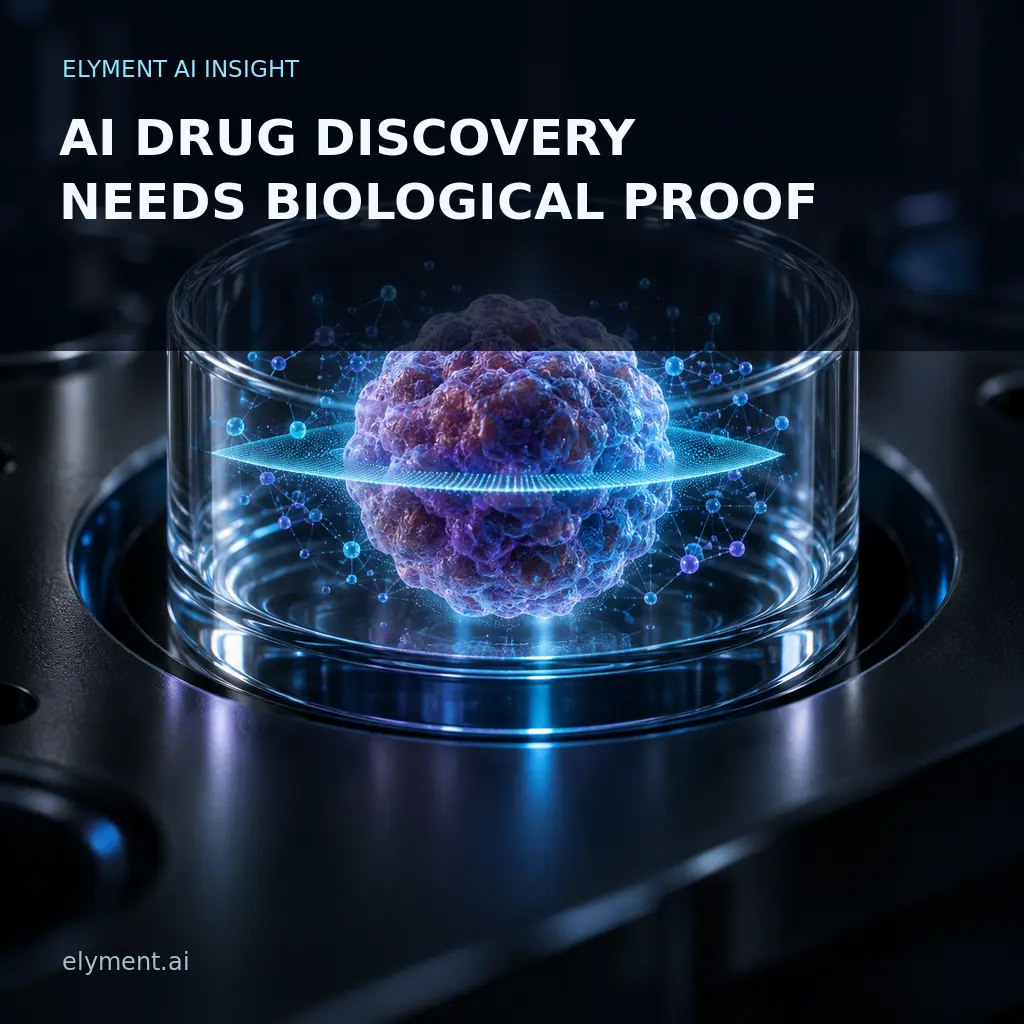
Gelomics' LunaX platform grows microscopic three-dimensional human tissue models, including tumour samples derived from patient biopsies, inside a specialised gel. Google says the platform can establish standardised tissue models in two to three weeks. Gelomics says LunaX is intended to make preclinical research more reproducible, scalable and human-relevant than conventional flat cell cultures.
This physical consistency is commercially important. If two samples differ because of uncontrolled culture conditions, an algorithm may learn laboratory variation rather than a drug's true effect. Standardised tissue models provide a more defensible basis for comparing experiments, retraining models and explaining why a candidate advanced or failed.
Where AI helps, and where evidence must take over
Gelomics plans to map each source biopsy cell by cell with the Queensland Spatial Biology Centre, capturing how large numbers of proteins and genes are arranged. Machine-learning models can then search for relationships among those molecular maps, measured laboratory responses and later clinical outcomes. The practical value is prioritisation: identify promising patient groups or drug candidates sooner, then test them with stronger experiments.
A 2026 perspective in BJC Reports supports this hybrid approach. It concludes that AI-assisted drug discovery has shown early translational feasibility, but broader validation, mechanistic understanding, regulatory alignment and prospective clinical evaluation remain essential. In other words, a confident prediction is a hypothesis to verify, not a substitute for biological or clinical proof.
Use a four-part evidence gate
Businesses evaluating AI for science, manufacturing or other evidence-heavy work should require four linked controls:
- Input control: define how samples, instruments and operating conditions are standardised and recorded.
- Traceability: connect every prediction to the source data, model version, experiment and decision owner.
- Independent verification: reproduce important results with held-out samples, external sites or conventional methods.
- Decision boundaries: state which outputs may prioritise work and which still require expert, regulatory or clinical approval.
What business leaders should do next
Do not begin with a broad promise to accelerate discovery. Choose one decision, such as selecting compounds for a follow-up assay, and define a manual baseline for time, cost, reproducibility and false leads. Track whether the AI-assisted process improves that decision without weakening evidence quality or obscuring accountability.
ELYMENT AI's analysis of AI research replication and physical-system standards shows the same pattern: models become operationally useful when organisations can reproduce outputs, inspect evidence and control the real-world interface. The Gelomics partnership is worth watching because it puts that interface, the biological experiment, at the centre of the AI system.
Sources
- Google Australia: How Gelomics is redefining cancer drug discovery (4 September 2026) - Primary announcement covering the partnership, technical workflow, intended early-stage use and mid-2027 prototype target.
- Gelomics: LunaX launch and reproducible 3D tissue culture (12 February 2026) - First-party background on LunaX and Gelomics' goal of scalable, human-relevant preclinical research.
- BJC Reports: Precision oncology in the age of AI (15 April 2026) - Independent open-access perspective on validation, transparency and clinical translation in AI-assisted drug discovery.
Continue learning
Frequently asked questions
What is Gelomics building with Google Australia?
Gelomics is developing an AI-assisted platform that links reproducible 3D human tissue models, molecular tumour maps, laboratory drug responses and clinical outcomes to support early-stage drug development and trial design.
Can the platform choose cancer treatments for patients now?
No. Gelomics is targeting a prototype for early-stage drug development in mid-2027. Individual patient treatment guidance is a longer-term goal that would require clinical validation.
What should businesses learn from the project?
AI predictions are only as dependable as the evidence system beneath them. Standardised inputs, traceability, independent verification and clear decision boundaries are essential for consequential workflows.