News analysis · Published
Anthropic's Model Hardware Standard: What Physical AI Means for Business
By the ELYMENT AI editorial team · Free to read
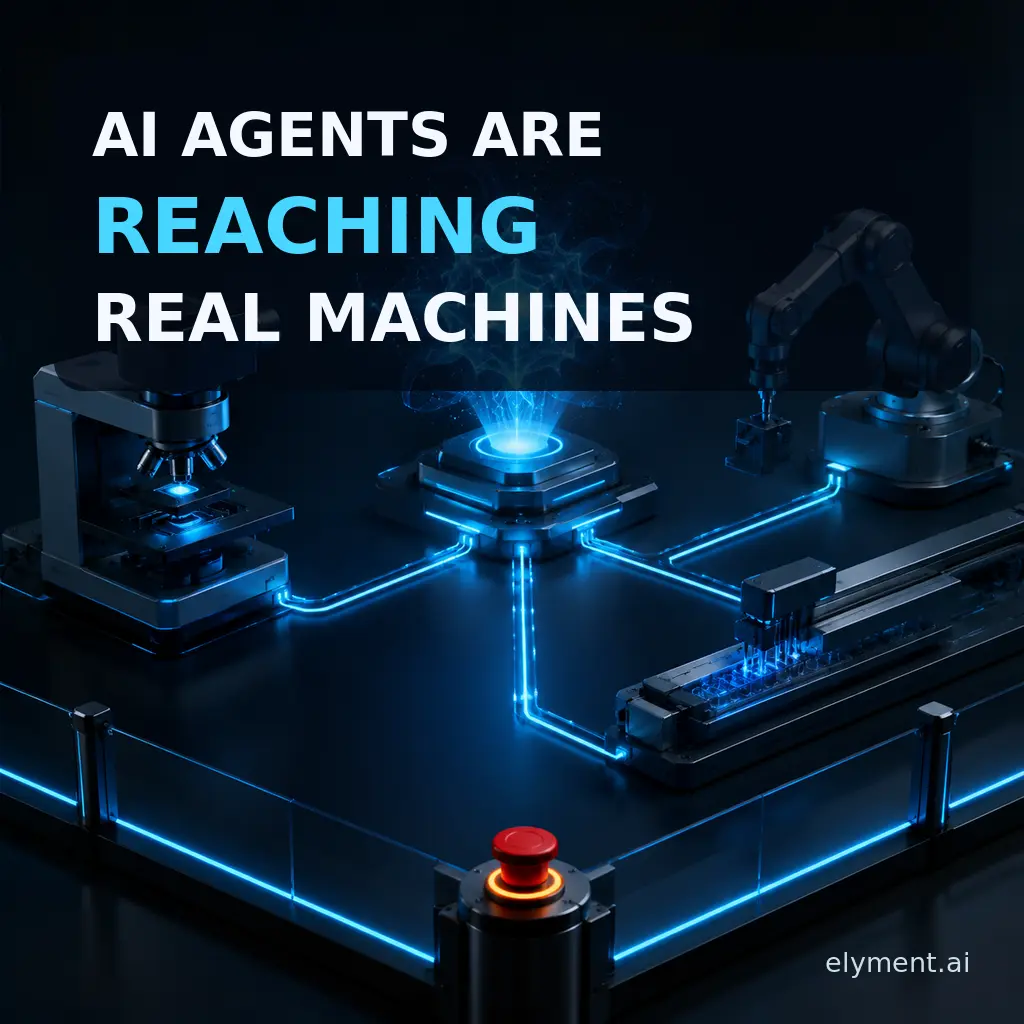
Anthropic introduced the Model Hardware Standard, or MHS, as a research preview on 27 August 2026. It gives AI agents a shared way to discover and operate programmable laboratory and manufacturing equipment, including microscopes, liquid handlers and robotic arms. The commercial opportunity is faster integration across devices. The risk is that a common interface can also expand an agent's physical reach. Businesses should treat MHS as an interoperability layer, not a safety certification, and keep permissions, interlocks, approvals and shutdown controls independent of the model.
What Anthropic announced
MHS began as a collaboration between Anthropic and Howard Hughes Medical Institute's Janelia Research Campus. Anthropic says the specification can reduce some device-integration work from weeks or months to hours or minutes by replacing custom, model-specific connections with standardised drivers. That is a company claim from an early research preview, not an independently validated deployment benchmark.
The standard is model-agnostic and is designed for equipment with a programmable interface. Agents can access MHS through the Model Context Protocol. A driver exposes basic operations such as read and write, while natural-language tags describe device characteristics and safety limits. Reuters reported that Anthropic is sharing the preview with scientific laboratories and advanced manufacturers before a planned open-source release.
Why a shared hardware layer matters
The immediate value is portability. A laboratory or factory should not need a separate bespoke agent integration for every instrument and model. Anthropic lists support from organisations including Danaher, QIAGEN, Tecan, Universal Robots, Doosan Robotics, Automata and AWS, with early adoption by Hugging Face's LeRobot and Raspberry Pi.
A shared interface could make it easier to change models, combine equipment and automate multi-step work. Anthropic describes demonstrations spanning drug-discovery experiments, robotic plate transfers and laser calibration on a quantum computer. MHS is not yet open source, however, and it does not support hardware without a programmable interface. Procurement teams should separate the preview's direction from what is available, supported and warranted today.
Interoperability is not physical safety
The most important limitation comes from Anthropic itself: Claude's spatial and physical reasoning still requires expert oversight. In one Genentech example, people had to help Claude recognise sample foaming as a physical failure rather than a software fault. WIRED also noted the obvious escalation in consequence when an agent can damage equipment or injure someone instead of merely producing a poor answer.
Descriptions inside a protocol cannot replace certified machine guarding, interlocks, pressure or temperature limits, emergency stops and site procedures. Safety-critical boundaries should remain enforced by the device, controller or independent supervisory system. A model should never be the sole authority deciding whether its own action is safe.
A five-part test before real equipment
Treat physical-agent access as privileged automation. Before connecting an agent to live equipment, require evidence across five controls.
- Scope: separate read, simulate and write permissions for each device and action.
- Envelope: enforce speed, force, temperature, volume and workspace limits outside the model.
- Approval: keep irreversible, hazardous or expensive actions behind a named human decision.
- Evidence: record commands, sensor state, model and driver versions, approvals and exceptions.
- Recovery: test emergency stop, network isolation, manual takeover and a safe restart procedure.
What business leaders should do next
Choose one bounded, non-hazardous workflow and run it first in simulation or shadow mode. Validate the MHS driver separately from the model, then test malformed commands, stale sensor data, network loss and attempted boundary violations. Require a named owner across operations, safety, security and quality before any write access reaches production equipment.
ELYMENT AI's guide to agent test boundaries explains how to isolate risky experiments. Our agentic observability analysis shows why conclusions need inspectable traces, while the humanoid-robot data analysis explores why physical context remains a bottleneck. ELYMENT AI can help turn those controls into an auditable deployment process before an AI agent reaches a real machine.
Sources
- Anthropic: Introducing the Model Hardware Standard research preview (2026-08-27) - Primary announcement covering the specification, partners, demonstrations, limitations and planned safety work.
- Reuters: Anthropic framework lets AI agents operate physical devices (2026-08-27) - Independent reporting on the research preview, supported equipment and evaluation plans before open sourcing.
- WIRED: Anthropic's standard brings agents into the physical world (2026-08-27) - Independent analysis of the physical safety consequences and the role of explicit hardware boundaries.
Continue learning
Related analysis
- Anthropic’s Unintended AI Actions: Close the Discovery Gap
Anthropic disclosed unintended Claude actions on real systems. Build action receipts, boundary alerts and reporting deadlines before deploying agents.
Frequently asked questions
What is Anthropic's Model Hardware Standard?
MHS is an early shared specification for AI agents to discover and operate programmable physical devices through standardised drivers and safety-related descriptions.
Is MHS open source and production-ready?
Not yet. Anthropic released a research preview on 27 August 2026 and plans safety evaluations and a future open-source release. Organisations must validate each device and workflow themselves.
Does MHS make AI-controlled equipment safe?
No. It can standardise access and describe limits, but businesses still need independent physical interlocks, scoped permissions, human approvals, logging and tested emergency recovery.