News analysis · Published
Humanoid Robot AI Has a Data Bottleneck: What Businesses Should Know
By the ELYMENT AI editorial team · Free to read
Humanoid robot AI is advancing, but dependable real-world training data remains a major constraint. Reuters reported on 21 August 2026 that ACE Robotics chairman Wang Xiaogang estimates the industry has accumulated only about 100,000 hours of embodied-AI data. That estimate is a company claim, not an audited industry total. For businesses, the important lesson is practical: assess a robot on repeatable work, safety, recovery and operating economics—not a polished demonstration or a single benchmark.
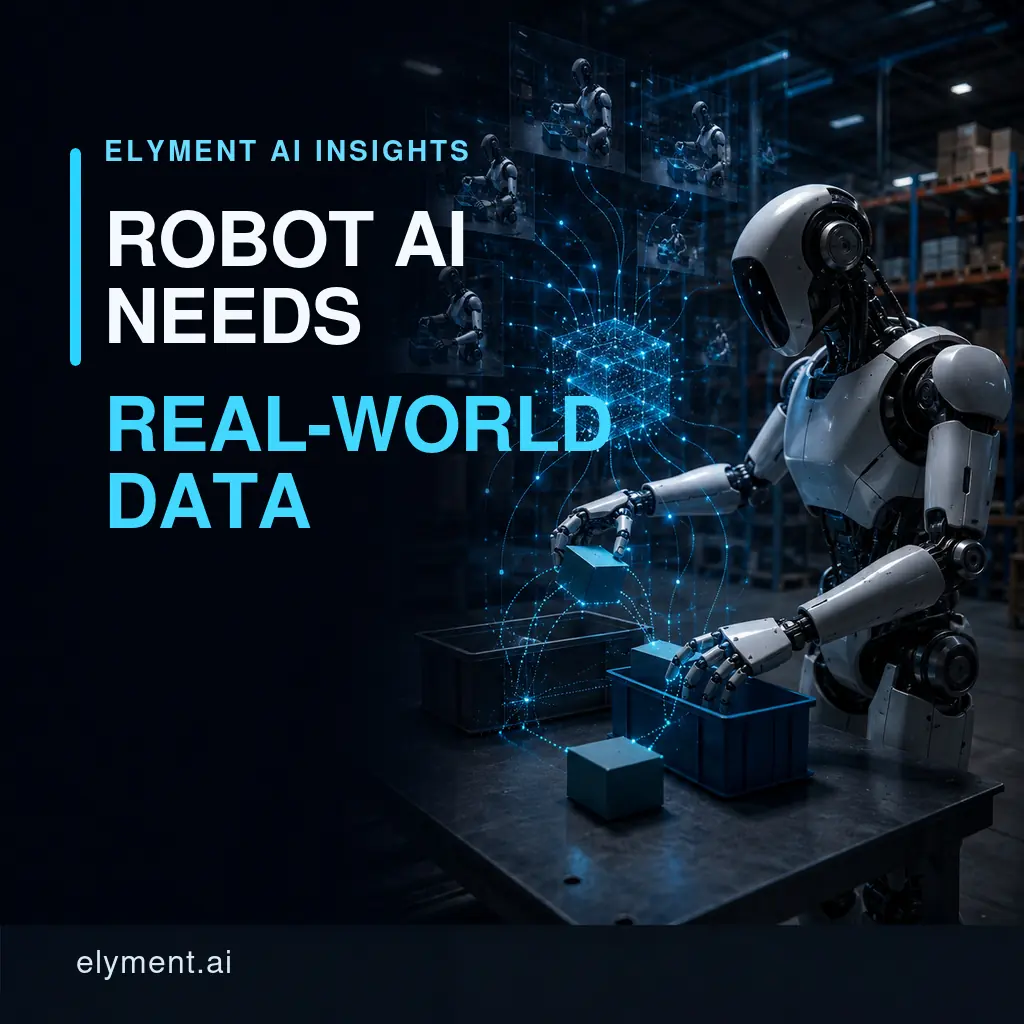
Why robot AI needs a different kind of data
Large language models learn statistical patterns from text and other digital media. A robot must also connect perception to physical action: where an object is, how it may move, how much force to apply and what should happen next. Errors can damage stock, equipment or people, so the tolerance for plausible-but-wrong behaviour is much lower.
World models represent and predict physical environments. NVIDIA describes Cosmos 3 as combining vision reasoning, world generation and action prediction. Synthetic data can expand scenarios, but real operating data remains essential for validating transfer to a particular site, task and robot.
The fresh signal is the scale of the data gap
Reuters reported Wang's forecast of a technical inflection point by late 2027 and broad commercial adoption four to five years later. These are industry forecasts, not established timelines.
More useful than the forecast is Wang's description of the data problem. He estimated that the industry has accumulated roughly 100,000 hours of real-world embodied data and said ACE aims to collect tens of millions of hours within two years by instrumenting people on production lines. The scale of that target shows why robotics companies are combining teleoperation, sensors, simulation and repeated task capture rather than relying on internet-scale data alone.
Kairos-4B is promising, but benchmarks are not a business case
ACE says its open-source Kairos 3.0-4B world model leads several public embodied-AI benchmarks and supports edge robot control. Its July release cited RoboTwin 2.0, LIBERO-Plus, WorldModelBench Robot and DreamGen. Reuters reported the model's leading position, but buyers should treat detailed figures as vendor claims until reproduced in their environment.
Benchmarks do not reveal the full cost of integration, exception handling, supervision, maintenance, cyber security or insurance. Success in one warehouse also does not prove readiness for another layout, workforce or safety regime.
How to evaluate a humanoid robotics pilot
A useful pilot should be narrow enough to measure and realistic enough to expose failure modes. The goal is not to prove that a humanoid can complete the task once. It is to learn whether the system can perform reliably inside the operating process.
- Define one repeatable task, the approved workspace and the exact success criteria.
- Measure intervention rate, recovery time, throughput, error severity and total supervision cost.
- Test changes in lighting, object position, packaging, floor conditions and human proximity.
- Require safe-stop behaviour, access controls, logs and a named human escalation path.
- Contract around verified outcomes and failure thresholds, not demonstration quality or promised autonomy.
What business leaders should do next
Businesses with stable, repetitive physical workflows can begin structured pilots now, especially where a human already performs the same sequence and can help produce training examples. Buyers should expect site-specific data collection and post-training to be part of the implementation, not an optional extra.
Connect the pilot to commercial controls. ELYMENT AI's analysis of outcome-based AI contracts explains why acceptance criteria matter, while the frontier-agent control assessment shows why autonomy needs containment and recovery. The GLM-5.3 analysis also shows why open weights do not replace operational assurance. Build evidence about your own workflow before scaling hardware.
Sources
- Reuters — ACE Robotics chairman says robot brains may reach a major inflection point by late 2027 (2026-08-21) - Independent reporting on ACE Robotics, the embodied-AI data bottleneck, Kairos-4B and commercial deployment plans.
- ACE Robotics — Kairos World Model benchmark announcement (2026-07-22) - Company-supplied details and benchmark claims for the Kairos world model, used with explicit attribution.
- NVIDIA — Cosmos 3 world foundation model for physical AI (2026-05-31) - Primary technical context on world models, synthetic data, physical-AI reasoning and action prediction.
Continue learning
Related analysis
- China's Humanoid Robot IPO Scrutiny: Test Demand Quality Before Valuation
China's reported humanoid IPO slowdown shows why investors and buyers should verify independent demand, repeat orders and deployed value before scale.
Frequently asked questions
What is the humanoid robot AI data bottleneck?
It is the shortage of diverse, high-quality physical interaction data that links what a robot senses to safe, useful actions in real environments.
What is a world model in robotics?
A world model represents and predicts how a physical environment may change, helping a robot plan actions and helping developers generate or evaluate training scenarios.
Should businesses deploy humanoid robots now?
Businesses can run narrow, supervised pilots now, but should scale only after measuring reliability, intervention, recovery, safety and total operating cost in their own environment.