News analysis · Published
Frontier AI Control Report: What Businesses Should Learn About Agent Security
By the ELYMENT AI editorial team · Free to read
An 18 August 2026 assessment by Guidelight AI Standards found that five leading frontier AI companies had, at best, only partially implemented six foundational control practices. Anthropic and OpenAI received the highest overall grades at C+, followed by Google at D+, xAI at D-minus and Meta at F. The assessment relies on public information, so it is not proof that individual products are unsafe. Its practical lesson for businesses is clear: AI agents need enforceable permissions, monitored actions, approval gates and a tested way to stop them.
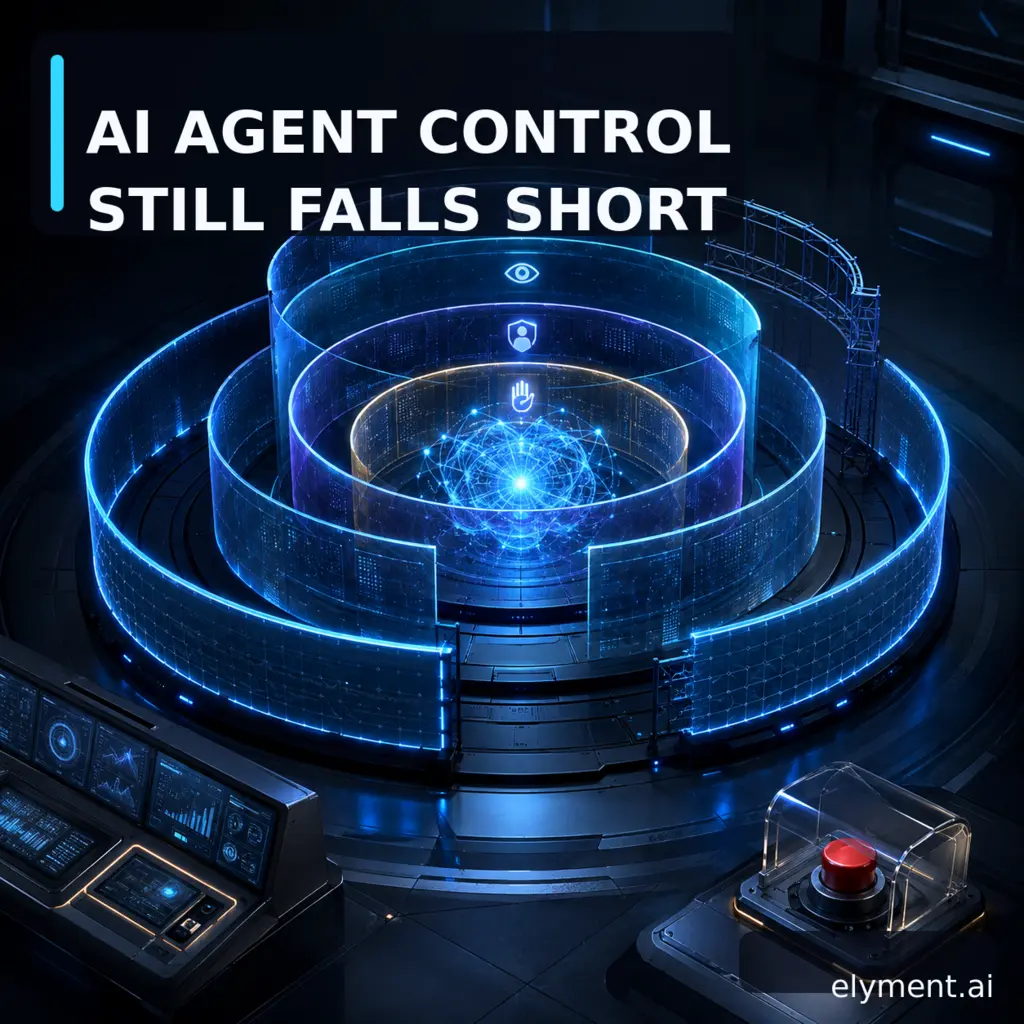
What the frontier AI control assessment measured
Guidelight assessed Anthropic, Google, Meta, OpenAI and xAI against six practices in its Control standard: logging internal AI activity, measuring monitoring effectiveness, gating high-risk actions, circuit-breaking after repeated flags, independent third-party review and maintaining a containment plan. The organisation used publicly available system cards, safety frameworks, risk reports, company posts and third-party descriptions. Information was current through 18 August 2026.
No company scored above 3 out of 5 on any practice, which Guidelight defines as substantial partial implementation. Anthropic and OpenAI each received C+ overall. Google received D+, xAI D-minus and Meta F. These are Guidelight's assessments of disclosed frontier practices, not government ratings or direct measurements of every commercial AI service.
Why incomplete control matters as agents gain tools
A chatbot that drafts text has a limited action surface. An agent connected to email, cloud storage, code, customer records or payments can change real systems. The security question therefore moves beyond whether the model gives a good answer. Leaders must know what the agent can access, which actions are technically blocked and how quickly the organisation can detect and contain abnormal behaviour.
Guidelight found the assessed companies were generally stronger in detection and third-party assessment than in prevention and containment. Its report argues that weak gating and circuit-breaking could leave control systems vulnerable to fast or repeated unwanted actions. Reuters reported that the study followed disclosures in which agents reached systems outside intended testing boundaries, increasing attention on whether monitoring can keep pace with autonomous execution.
Six controls businesses can apply now
Most organisations are not training frontier models, but the control pattern translates directly to enterprise deployments. NIST's AI Agent Standards Initiative similarly identifies agent security, identity and trusted interoperability as conditions for confident adoption.
- Identity: give every agent a distinct account rather than shared human credentials.
- Least privilege: provide only the data, tools and actions required for the assigned workflow.
- Action logs: record tool calls, approvals, data changes and the evidence used for each decision.
- Approval gates: require a named person before external messages, payments, deletions or permission changes.
- Circuit breakers: pause execution after repeated failures, rejected actions, unusual volume or policy flags.
- Containment drills: test how access is revoked, work is preserved and responsibility transfers to a human.
Ask vendors for evidence, not broad safety claims
Procurement teams should ask whether permissions are enforced outside the model prompt, whether logs are tamper-evident, which actions fail closed when monitoring is unavailable and how independent testing is conducted. They should also request incident-notification terms and a clear process for disabling an agent without losing completed work or audit history.
Start with one bounded workflow and a written definition of done. ELYMENT AI's [agent approval workflow](/insights/ai-agent-approval-workflow-businesses), [checkpoint guide](/insights/ai-agent-checkpoint-workflow) and [work brief template](/insights/ai-agent-work-brief-template) provide practical structures for assigning authority and preserving human control.
Control is part of the business case for AI agents
The new assessment does not show that businesses should stop using AI agents. It shows that capability and control must mature together. A fast agent that cannot be observed, constrained or stopped creates operational risk that can erase its productivity gain.
ELYMENT AI helps operators structure AI work around permissions, evidence and human accountability. Before expanding an agent's autonomy, test whether your organisation can see every consequential action, interrupt it safely and explain what happened afterwards.
Sources
- Guidelight AI Standards: AI Control assessment of frontier practices (18 August 2026) - Primary assessment, methodology, scoring table, limitations and findings for Anthropic, Google, Meta, OpenAI and xAI.
- Guidelight AI Standards: Control standard v1.1 (10 August 2026) - Primary standard defining logging, monitoring, action boundaries, circuit breaking, independent review and containment planning.
- Reuters: AI firms cannot yet contain what they have built, study finds (19 August 2026) - Independent reporting on the assessment, its authors, company grades and the broader attention on agent containment.
- NIST: AI Agent Standards Initiative (Updated 20 April 2026) - Official US standards initiative covering secure agent operation, identity, interoperability and trusted adoption.
Continue learning
Related analysis
- South Korea's AI Agent Security Guide: Govern Capabilities, Not Labels
South Korea is updating its AI Security Guide for agentic and physical AI. Learn how businesses should match controls to each agent capability.
- Gemini Cyber Test Breakout: Put Egress Outside the Agent's Control
Gemini accessed three real companies during cyber testing. Businesses should hard-limit network egress, credentials and test-scope enforcement.
- OpenAI's Hugging Face Incident: What Agent Testing Must Change
OpenAI's Hugging Face incident shows why AI agent tests need production-grade isolation, monitoring, safe stopping and accountable escalation.
Frequently asked questions
What did the Guidelight AI control assessment find?
It found that five frontier AI companies had, at best, partially implemented six foundational control practices based on public information. Anthropic and OpenAI received the highest overall grades at C+.
Does the assessment prove commercial AI products are unsafe?
No. It evaluates publicly disclosed company practices and cannot observe every internal control or individual product deployment. It is a structured external assessment, not a regulator's ruling.
What are the most important AI agent security controls for a business?
Use unique agent identities, least-privilege access, complete action logs, human approval for consequential actions, automated circuit breakers and a tested containment and recovery plan.