News analysis · Published
China Ordered Meta's Manus Deal to Be Unwound: An AI Vendor Risk Checklist
By the ELYMENT AI editorial team · Free to read
China's 27 April security-review decision ordered the parties to withdraw the acquisition of Manus, an AI-agent company that had announced it was joining Meta. The practical lesson for business buyers is simple: an AI vendor's incorporation address is not the whole risk picture. Data, intellectual property, R&D, key staff and operating control can all affect continuity when a regulator intervenes. No public source confirms that the legal and financial unwind has been completed.
What China's order actually says
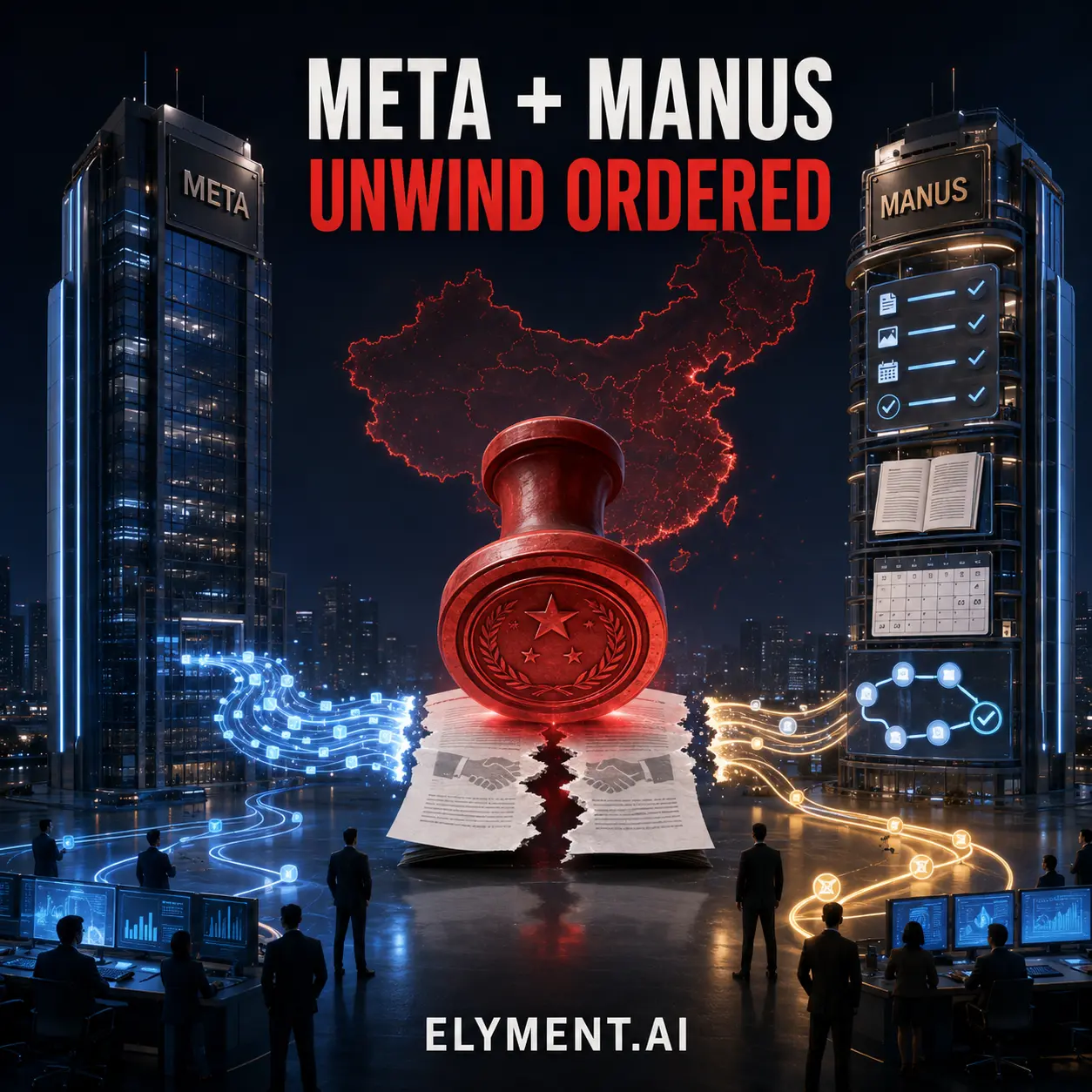
On 27 April 2026, the Office of the Working Mechanism for Security Review of Foreign Investment, within China's National Development and Reform Commission (NDRC), issued a decision prohibiting foreign investment in the Manus project and requiring the parties to withdraw the acquisition. The brief official notice did not name Meta or give detailed reasons.
Reuters identified the transaction as Meta's US$2 billion-plus acquisition of Manus. Manus had announced in December that it was joining Meta and would continue operating from Singapore. Those facts need to stay separate in any board or procurement briefing: the official order names Manus, while reliable reporting connects it to Meta's deal.
Why this matters beyond one deal
Manus is an AI agent platform designed for research, automation and complex task execution. With agentic products, a change in ownership or access can affect more than a licence agreement. It can alter the people maintaining a workflow, the systems it can reach, the location of operational data and the availability of a critical service.
Reuters reported that the case highlighted Beijing's view that the origin of technology, R&D, data flows and historical operations can remain relevant even if an entity is registered elsewhere. That is not a legal conclusion. It is a practical reminder that the vendor-risk question is broader than where a parent company is incorporated.
An AI vendor continuity checklist
Treat this as operational guidance, not legal advice. For each AI worker that handles material work, map the business process, systems it can access, data categories, human owner and fallback. The aim is to keep the work moving safely if a supplier's ownership, regulatory position or service changes.
Ask where the product's core IP and R&D originated, where service and support are run, and whether use depends on entities, infrastructure or staff in multiple jurisdictions. Contract terms, data-processing arrangements and exit rights should match the importance of the workflow.
- Keep an approved human fallback for client communications, financial changes and other irreversible actions.
- Document the prompts, tools, permissions and business rules needed to recreate a critical workflow.
- Set a review trigger for material changes in vendor ownership, data location, sanctions exposure or regulatory status.
Governed AI work needs a continuity plan
A supplier disruption should be treated as an operating scenario, not an abstract legal risk. A governed AI worker has a narrow role, clear permission boundary, human approval points and a traceable process. That gives a team the ability to pause, replace or reroute the work instead of discovering hidden dependencies after an event.
The ELYMENT.AI perspective is practical: build reliable work systems first, then choose the models and vendors that serve them. When governance, approvals and workflow ownership are visible, a business is better placed to adapt without sacrificing service or control.
Sources
- National Development and Reform Commission: security-review decision on Manus (27 April 2026) - Official decision prohibiting foreign investment in the Manus project and requiring the parties to withdraw the acquisition.
- Manus: Manus joins Meta for next era of innovation (29 December 2025) - Manus announced it was joining Meta and said it would continue operating from Singapore.
- Reuters: China orders Meta to unwind $2 billion purchase of AI startup Manus (27 April 2026) - Reports the NDRC order in connection with Meta's US$2 billion-plus acquisition and the cross-border context.
- Reuters: Manus original investors plan to buy back AI firm from Meta (18 June 2026) - Reports a proposed investor buyback after the order, rather than a completed legal and financial unwind.
Continue learning
Frequently asked questions
Did China order Meta's Manus deal to be unwound today?
No. The NDRC decision was dated 27 April 2026. This is a policy and business analysis of its ongoing implications. The official notice did not name Meta, while Reuters reported that the order concerned Meta's acquisition of Manus.
Has the transaction been fully unwound?
No public source confirms that the legal and financial separation is complete. Meta said it complied with applicable law and expected an appropriate resolution. Later reporting indicated operational separation, while an investor buyback was still reported as planned.
Does overseas incorporation remove AI vendor jurisdiction risk?
Not necessarily. The Manus case suggests buyers should examine actual technology, data, talent, historical operations and regulatory links. Obtain specialist legal advice for a transaction or high-risk deployment.