News analysis · Published
EgoLAP: Test Human-to-Robot Transfer Before You Scale
By the ELYMENT AI editorial team · Free to read
EgoLAP, submitted to arXiv on 6 October 2026, is a vision-language-action research framework that translates human and robot motion into a shared language-based representation. Its authors report 80.1% mean real-world task progress and a 2.3 times gain over alternative action representations. That is promising evidence, not a commercial guarantee. Leaders evaluating robot learning from human video should require three gates before scale: reproduce the task on the target robot, validate it under site conditions, and measure safe recovery from foreseeable variation.
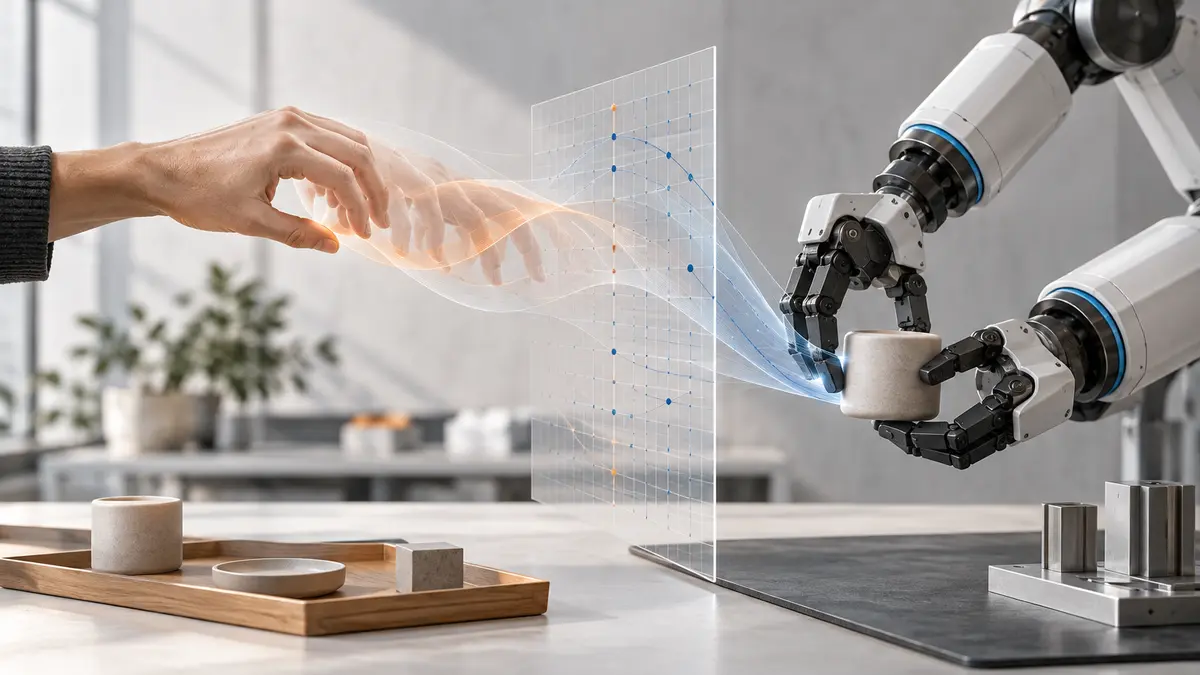
What EgoLAP changes in robot learning
Robot teams often demonstrate on target hardware, which is costly and limits coverage. Egocentric human video is more abundant, but human hands and robot grippers differ in body, kinematics and control interface: the embodiment gap identified in the paper.
Researchers from Princeton University, Toyota Research Institute and Physical Intelligence encode motion intent as structured language actions. “Move forward, rotate, close the gripper” gives human and robot trajectories a shared target. Motion-level reasoning links actions to scene geometry, contact, physics and object affordances. Textual targets guide training; the action expert outputs control commands at inference without generating text.
What the reported results do and do not prove
Across the authors' real-world and simulated experiments, motion-level reasoning outperformed a composite of subtask, object-box and visual-trace reasoning.
These preprint results from a defined setup do not establish reliability on a buyer's robot, tooling, objects, lighting, cycle time or safety system. Mean progress can hide contact errors, long recovery or inconsistent final placement. Treat transfer as a hypothesis; test the operating claim you need.
Use a three-gate transfer acceptance test
Gate one—embodiment: reproduce representative tasks on the intended robot, end effector and controller. Compare completion, path quality, contact errors and human interventions with a robot-only baseline; record source video, model version, calibration and instructions.
Gate two—site: test production objects, camera positions, lighting, background clutter and tolerances, including geometry or affordance changes rather than cosmetic variation. Gate three—recovery: introduce slips, partial grasps, shifted objects and interruptions. Measure whether the system stops, retries, escalates or continues incorrectly.
- Embodiment: prove the policy on the actual robot and tooling.
- Site: test production geometry, sensing, tolerances and pace.
- Recovery: measure safe behaviour after contact and sequence failures.
What business leaders should do now
Separate training-data scale from deployment evidence. Human video may broaden learned behaviours, but approval should require repeatable outcomes, bounded failure modes and recovery owned by operations and safety teams.
Start with one economically relevant task and a dated acceptance record. Define the baseline, minimum success rate, intervention limit and stop conditions before the trial. ELYMENT AI helps organisations turn AI capability into measurable operating decisions without treating demonstrations as production proof.
Sources
- arXiv: EgoLAP: Learning from Egocentric Human Data through Language-Action Reasoning (6 October 2026) - Primary preprint with the abstract, authors, submission date and reported real-world task-progress results.
- EgoLAP project website (6 October 2026) - First-party project page linked by the paper, providing videos and visual examples of the method and experiments.
Continue learning
Frequently asked questions
What is EgoLAP?
EgoLAP co-trains egocentric human and robot trajectories through shared language actions and motion-level reasoning for robot control.
Does EgoLAP prove that human video can replace robot demonstrations?
No. Its experiments report stronger transfer; buyers must test their robot, tooling, objects, site conditions and recovery requirements.
How should a business evaluate human-to-robot learning?
Use three gates: reproduce tasks on the target robot, validate at the site, and measure safe recovery from foreseeable variation and failure.