News analysis · Published
Gemini 3.7 Flash: What Google's New Agent Model Means for Business AI
By the ELYMENT AI editorial team · Free to read
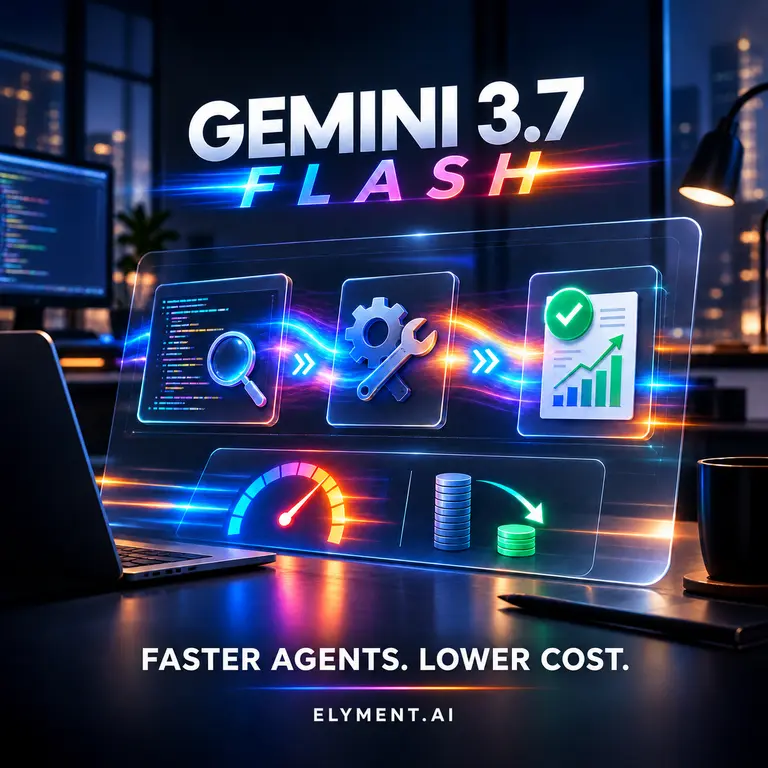
Google launched Gemini 3.7 Flash on 13 August 2026 as a stable model for coding, multimodal reasoning and agentic workflows. Its practical attraction is not simply another benchmark cycle. Google has set temporary standard paid-tier pricing of US$0.75 per million input tokens and US$3.75 per million output tokens through 31 December 2026. For businesses, that creates a useful testing window: compare the model on one bounded workflow, measure the cost of a correct completed outcome and retain approval gates for consequential actions.
What Google released
Google's documentation lists Gemini 3.7 Flash as a stable model and describes it as its most capable Flash model for agentic workflows and multimodal reasoning. It accepts text, images, video, audio and PDFs, and produces text. Supported capabilities include function calling, code execution, file search, structured outputs and search grounding. Computer use is listed as a preview capability, which is an important distinction for production planning.
Reuters reported that the model is aimed at coding and automated business tasks, including systems that plan work, use software tools and complete multi-step workflows. Google also began rolling it into Gemini Spark. These are launch facts, not proof that it will outperform another model inside a particular business process.
The price changes the testing economics
Google's standard paid-tier price is temporarily US$0.75 per million input tokens and US$3.75 per million output tokens, including thinking tokens, through 31 December 2026. From 1 January 2027, the published rates rise to US$1.50 and US$7.50 respectively. Batch, Flex, grounding, caching and other services have separate meters, so a token headline is not the total cost of an agent run.
Lower introductory pricing makes it cheaper to run representative evaluations, retry difficult cases and compare model choices. It should not encourage unbounded automation. A weak workflow can consume inexpensive tokens while still creating expensive human corrections, customer risk or operational delay.
Test one real workflow before switching
Choose a recurring job with a clear finish line, such as reviewing a code issue, classifying incoming documents or preparing an internal account brief. Run the same representative cases through the current model and Gemini 3.7 Flash. Keep prompts, tools, source material and authority limits consistent so the comparison is meaningful.
Measure completion accuracy, tool-call success, elapsed time, input and output consumption, human correction time and total cost per accepted result. Record failures by type. A lower token bill matters only when the workflow reaches the required outcome reliably.
- Quality: did the output meet the agreed definition of done?
- Reliability: did every tool call use the right data and parameters?
- Cost: what did an accepted completed result cost, including retries?
- Control: did the worker stop at customer, payment, permission or irreversible-action boundaries?
Keep governance independent of the model
A faster model should not inherit broader authority automatically. Keep approved sources, tool permissions, spend ceilings, audit records and named reviewers outside the model choice. Require approval before external communication, financial commitments, access changes or edits to sensitive records. If computer use is part of the test, treat its preview status as a reason for tighter observation and narrower permissions.
This separation also protects continuity. Models, prices and availability change. A governed workflow can substitute another suitable model without rebuilding the business rules that define what the worker may do.
Turn the launch into a measured decision
Gemini 3.7 Flash gives businesses a credible new option for agentic and coding work, plus a time-limited price window for evaluation. The sensible response is a controlled comparison, not a platform-wide migration based on launch-day claims.
ELYMENT.AI brings AI work, business context and human oversight into one workspace. [Start with ELYMENT.AI](/login) and map one bounded workflow with a measurable outcome before deciding where a new model earns a place.
Sources
- Google AI for Developers: Gemini 3.7 Flash (Last updated 13 August 2026) - Official model documentation covering stability, modalities, token limits and supported capabilities.
- Google AI for Developers: Gemini API pricing (Accessed 15 August 2026) - Official pricing page for the temporary standard, Batch, Flex and Priority rates and the 1 January 2027 price change.
- Reuters: Google unveils Gemini 3.7 Flash (13 August 2026) - Wire reporting on the launch, intended coding and agent-workflow uses, introductory price and Gemini Spark rollout.
Continue learning
Frequently asked questions
What is Gemini 3.7 Flash designed for?
Google positions Gemini 3.7 Flash for complex coding, multimodal reasoning and reliable multi-step agent workflows. Its documentation lists function calling, code execution, file search, structured outputs and search grounding as supported capabilities.
How much does Gemini 3.7 Flash cost?
Google's standard paid tier is US$0.75 per million input tokens and US$3.75 per million output tokens through 31 December 2026. Published rates rise to US$1.50 and US$7.50 from 1 January 2027. Other services and inference tiers can add separate costs.
Should a business replace its current AI model immediately?
No. Test Gemini 3.7 Flash against representative cases in one bounded workflow. Compare accepted-result cost, quality, tool reliability, correction time and governance before expanding its role.