News analysis · Published
Hesai Kosmo: Govern the Spatial Data Supply Chain
By the ELYMENT AI editorial team · Free to read
Hesai launched Kosmo on 14 October 2026 as a system for capturing physical spaces and turning them into reusable 3D assets for robotics and simulation. Faster capture can lower the cost of building training environments, but it also creates a new data supply chain. Businesses should govern each scan through five controls: permission, scope and exclusions, provenance, versioning, and real-world validation. That makes spatial data reusable without treating provider claims or a digital twin as proof that a robot will perform safely. [1][2]
What Hesai launched
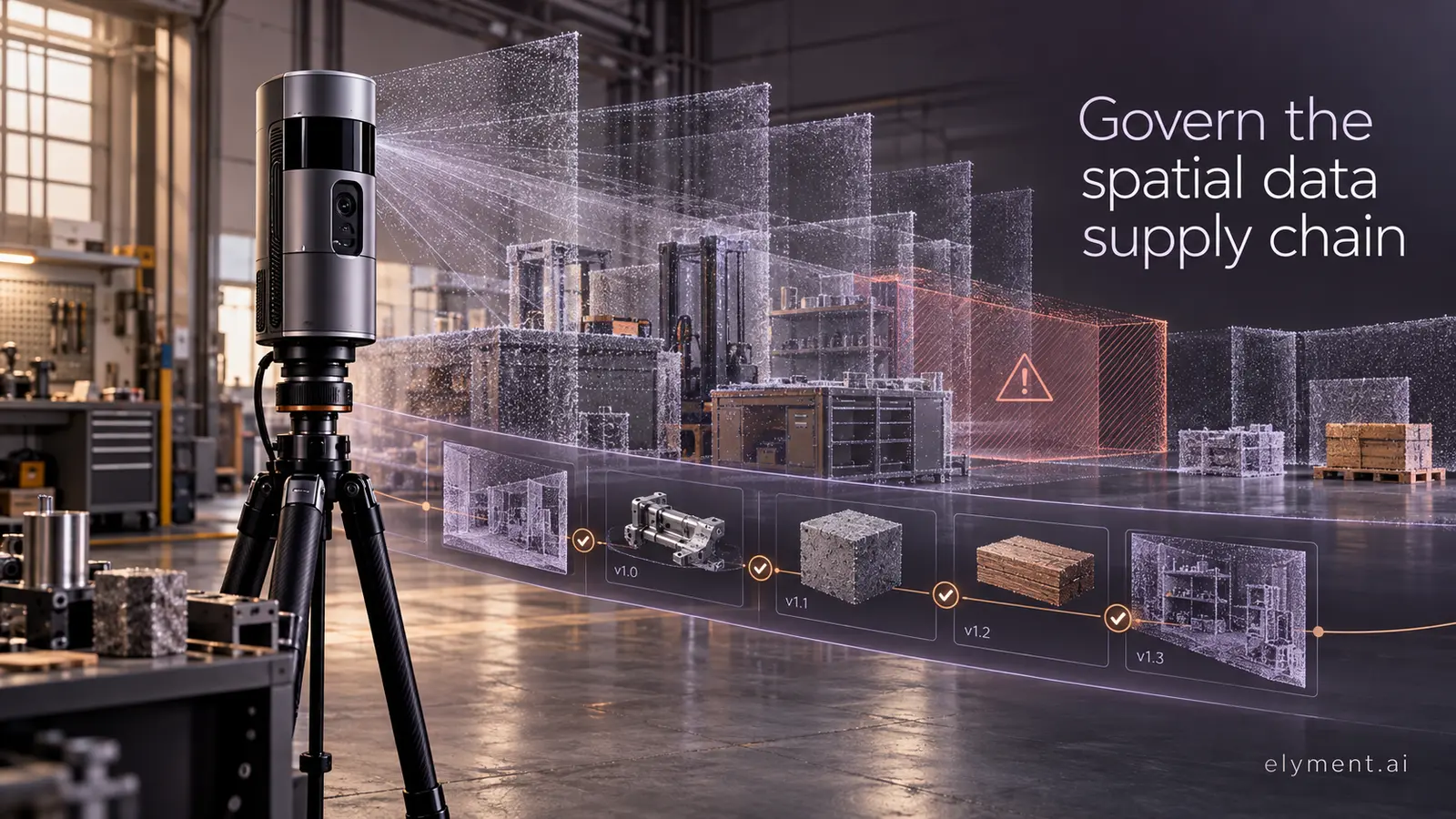
Kosmo combines the Kosmo One spatial camera with the Kosmo World platform. Hesai says the camera records geometry, colour, texture and camera position using lidar, a one-inch imaging sensor and an inertial measurement unit. The platform then processes those captures into 3D assets for uses such as robot training, simulation and digital twins. [1]
The company says a typical 100-square-metre indoor room can be scanned in about 15 minutes. In a Dairy Queen case study within the announcement, Hesai reported that a reconstruction job previously estimated at 300 manual hours was completed with 15 minutes of scanning, while the resulting policy achieved 99 per cent task success and one-tenth the prior failure rate. Those are vendor-reported results from a cited deployment, not an independent benchmark. Reuters separately confirmed the launch and the 99 per cent claim. [1][2]
The value sits in reuse, and so does the risk
A reusable spatial asset can support many downstream decisions: layout planning, synthetic data generation, navigation tests and manipulation policies. That leverage is commercially useful because one capture may serve several teams. It also means one consent gap, stale geometry or missing exclusion can spread into several models and environments.
A scan should therefore be treated as governed source data, not as a neutral photograph of a room. It may reveal security arrangements, staff behaviour, customer information, valuable equipment or hazardous operating conditions. Businesses need to know who authorised capture, what was deliberately omitted, which transformation produced each derivative and when a material change requires a fresh scan.
Use a five-field spatial data record
NIST's AI Risk Management Framework playbook recommends documenting data provenance, transformations, labels, dependencies and constraints, and testing systems under conditions similar to deployment. A compact record can apply that discipline to every physical environment. [3]
- Permission: record the site owner, lawful basis, people notified, approved purpose and accountable business owner.
- Scope and exclusions: define rooms, objects, time windows and sensitive zones that may or may not be captured.
- Provenance: preserve device, firmware, calibration, operator, timestamp, source files and every material transformation.
- Version: issue a durable identifier, change reason, superseded asset and retention or deletion rule for each release.
- Validation: test the trained or simulated behaviour in the real operating environment, including edge cases and stop conditions.
What business leaders should do now
Start with one bounded environment and one decision. Require the capture record before files enter a training or simulation pipeline, then trace every derivative model back to the approved version. Keep provider performance claims separate from your own acceptance evidence, and stop reuse when the physical space, robot, task or risk boundary changes.
Procurement should cover export formats, deletion, access logs, subcontractors, incident handling and the right to retrieve source assets without a platform dependency. ELYMENT AI helps teams connect evidence, owners, approvals and recovery actions so spatial AI can move from an impressive scan to a controlled operating system.
Sources
- Hesai: Kosmo 3D World Data Engine launch (2026-10-14) - First-party announcement covering the camera, platform, stated capture workflow and provider-reported customer case.
- Reuters: Hesai launches spatial camera for AI-powered robotics (2026-10-14) - Independent reporting on the launch, robotics customers and Hesai's reported task-success result.
- NIST AI RMF Playbook: Measure (2023-01-26) - Authoritative guidance on data provenance, documentation, transformation records and deployment-relevant testing.
Continue learning
Frequently asked questions
What is Hesai Kosmo?
Kosmo is Hesai's combination of a spatial camera and cloud platform for capturing physical environments and turning them into reusable 3D assets.
Why does spatial data need governance?
One capture can be reused across simulations, models and teams, so permission gaps, stale geometry or hidden exclusions can propagate into several business decisions.
Does a successful simulation prove a robot is ready?
No. Simulation evidence should be followed by bounded real-world testing under representative conditions, with explicit stop, rollback and review criteria.