News analysis · Published
South Australia’s AI Royal Commission: What Businesses Should Prepare For
By the ELYMENT AI editorial team · Free to read
South Australia’s announced Royal Commission into artificial intelligence is a signal that AI adoption is becoming a governance and operating-model question, not simply a software choice. It is not a new law or an immediate compliance requirement for every business. But organisations that can show what their AI workers do, what data they use, who approves consequential actions and how they correct mistakes will be better placed as policy, customers and partners ask harder questions.
What has been announced
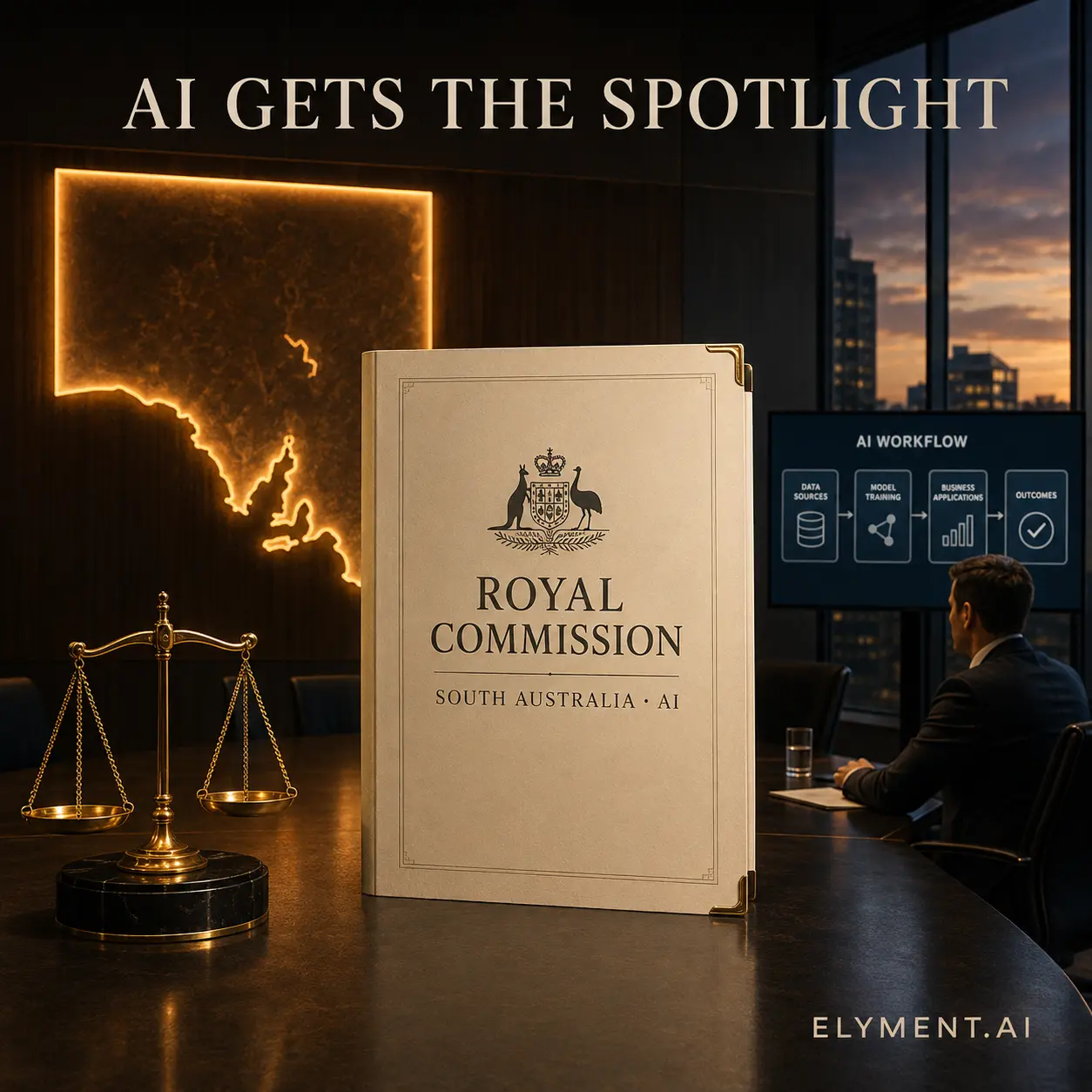
On 10 August, the South Australian Premier announced a Royal Commission into AI. Reporting says the inquiry will examine AI’s benefits and risks across areas such as education, public services, health and the arts. The announcement follows a period in which South Australia has already built an Office for AI and published work on responsible, community-focused public-sector adoption.
The practical point for business is not to predict the commission’s recommendations. It is to recognise the direction of travel. AI that influences people, money, information or decisions will increasingly be expected to be understandable, accountable and safely operated.
A Royal Commission is not a reason to freeze AI
Do not pause a useful internal AI workflow because an inquiry has been announced. Equally, do not treat a fast-moving model or agent as a reason to skip basic control design. Begin with a bounded job: classify an enquiry, prepare a document summary, retrieve approved information or draft an internal response. Give the worker a clear purpose, a limited tool set and an accountable owner.
Keep external commitments, payments, permissions and sensitive-record changes behind a named approval. This creates a simple distinction between an AI system that helps a person work and a system that silently acts on the organisation’s behalf.
- Name the workflow owner and the decision-maker for exceptions.
- Record the source material, proposed action, reviewer decision and final outcome.
- Set a pause control and a recovery path before connecting a worker to a live system.
Build the evidence before someone asks for it
The South Australian Office for AI describes governance work built around policy guardrails, stage gates and escalation points. Those principles transfer well to commercial use. Keep an up-to-date list of AI tools and connected data, document what each workflow is allowed to do, and test its output against representative cases before broadening access.
For a customer-facing worker, make it easy to see what it relied on, which account or record it touched and where a person approved the release. For an internal worker, measure correction rate, time saved, cost per completed task and tool failures. This is practical operational evidence, not paperwork for its own sake.
The opportunity is trusted adoption
The businesses that benefit most from AI will not necessarily be the first to turn every task autonomous. They will be the ones that can move quickly inside clear boundaries. A governed process makes it easier to trial a better model, add a useful integration or demonstrate to a client why the result can be trusted.
ELYMENT.AI is built around AI workers, business context and human control. Start with one defined outcome, make the approval and escalation path visible, then measure the result. [Start with ELYMENT.AI](/login) to map your first governed workflow.
Sources
- The Guardian: SA premier announces Royal Commission into AI (10 August 2026) - Reports the South Australian Premier’s announcement of a Royal Commission into AI and its intended examination of AI’s societal impacts.
- news.com.au: South Australia announces Royal Commission into AI (10 August 2026) - Reports the announced inquiry, its planned start and its focus on AI’s effects across public and social sectors.
- South Australian Office for AI: About our work (27 July 2026) - Sets out the Office for AI’s work on responsible adoption, including policy guardrails, stage gates and escalation points.
Continue learning
Frequently asked questions
Is South Australia’s AI Royal Commission a new law for businesses?
No. An announced Royal Commission is an inquiry, not an immediate new compliance regime. Businesses should follow the rules that already apply to their sector and treat the announcement as a reason to strengthen practical governance.
What is the first AI governance record a business should create?
Create a short register of each AI workflow: its purpose, owner, data sources, connected tools, authority limits, approval steps, escalation contact and success measure. Keep it current as the workflow changes.
Can a small business use AI safely without a large compliance team?
Yes. Start small. Use a bounded task, approved sources, a named reviewer for consequential actions and a clear way to stop or correct the workflow. Consistent operating habits matter more than a large document set.