News analysis · Published
Together AI's India AI Factory: What 10,000 GPUs Mean for Business AI
By the ELYMENT AI editorial team · Free to read
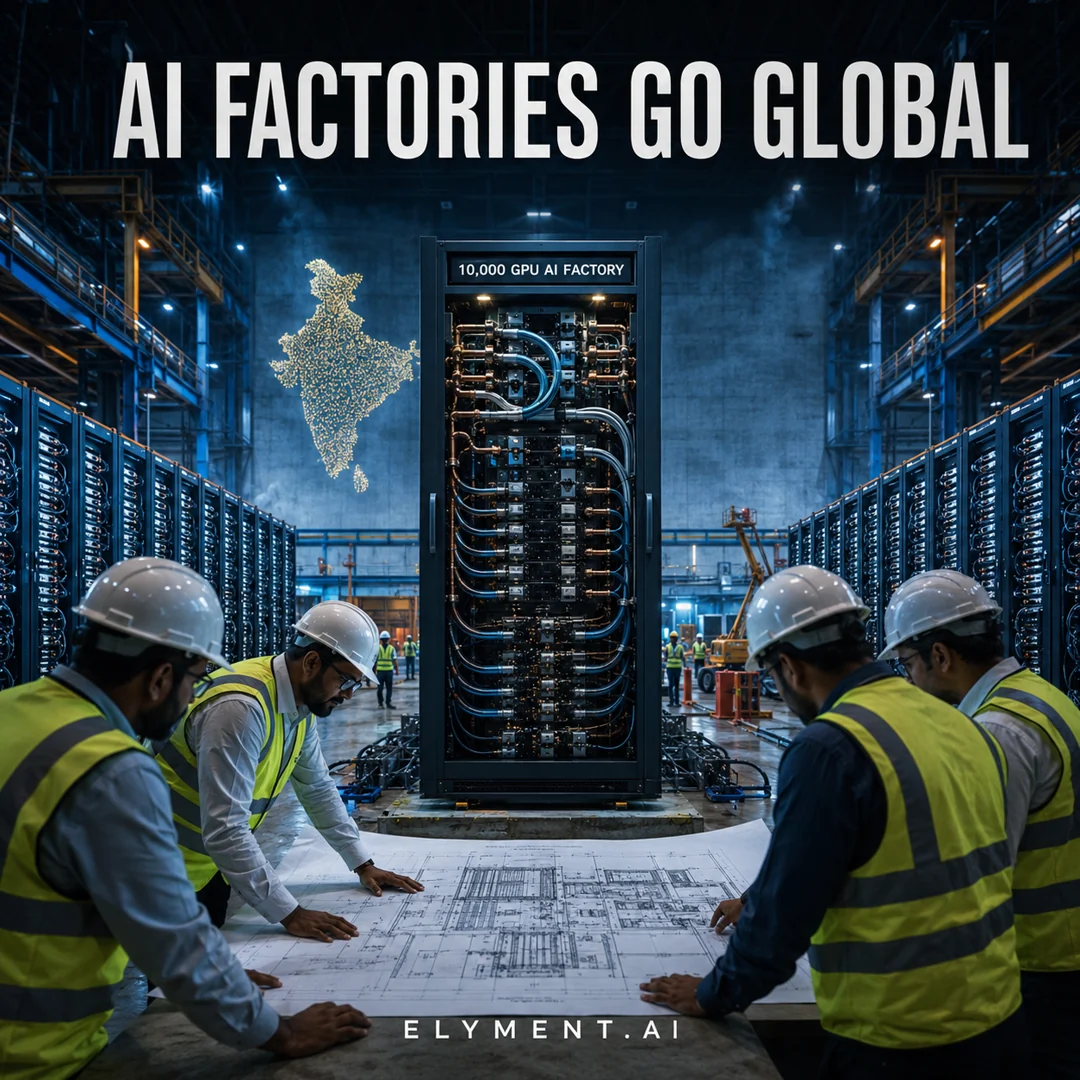
Together AI's reported India AI-factory order matters because the location and scale of computing capacity are becoming practical business considerations, not merely a concern for hyperscalers. Reuters reported on 13 August that Larsen & Toubro had secured a 100 to 150 billion rupee order from Together AI to build an AI data centre using Nvidia chips. The Economic Times reported that the project would deploy 10,000 Nvidia B300 GPUs in Chennai. The build is not a promise of immediate capacity, pricing or availability for every business, but it is a clear signal that AI infrastructure is being built in more regions and at industrial scale.
What has been reported
Larsen & Toubro said it had won a major order from the US cloud platform Together AI to build an AI data centre in India, according to Reuters. Reuters put the order value at 100 to 150 billion rupees. The report did not establish a public completion date or a customer-access timetable.
The Economic Times separately reported a Chennai campus with 10,000 Nvidia B300 GPUs, describing it as a large single-cluster AI infrastructure project. Treat that hardware count as reported project detail, not as a currently operating service. The distinction matters: an order, a construction programme and available AI capacity are different milestones.
Why regional compute changes the business conversation
For most teams, the immediate question is not whether to buy GPUs. It is whether important AI workflows depend on one provider, one region or one short-term capacity assumption. More regional AI factories may eventually improve choice and resilience, but a new facility does not automatically solve latency, data-handling, commercial or integration requirements for a particular workload.
The useful shift is to treat model access and compute location as operating assumptions that should be documented. A customer-support drafting worker, document-processing flow or internal research assistant should have a named provider, data boundary, cost measure, fallback and owner. That makes it possible to respond calmly when capacity, pricing or a provider's terms change.
Three checks before AI capacity becomes a constraint
First, separate the business workflow from the model endpoint where practical. Preserve the task definition, approved knowledge, tools, output format and evaluation examples so a team can test a second option without rebuilding the process.
Second, measure the actual workload. Track completion quality, response time, token or run cost, exception rate and provider failures on representative work. A headline about infrastructure is not evidence that a model is right for an invoicing, sales or operations process.
Third, place approvals around consequences. An AI worker may prepare a client response or document summary, but a person should retain control of pricing, external commitments, financial changes and sensitive records until the workflow has earned trust.
- Record the region, provider and fallback for critical AI workers.
- Test a bounded workflow with real examples before changing production architecture.
- Keep approval gates for customer, financial and irreversible actions.
- Review cost and reliability alongside model quality.
The opportunity is readiness, not hype
The reported Together AI build is a useful marker of a broader infrastructure race: AI capability increasingly depends on where capacity is financed, built and operated. Businesses do not need to predict the winning region or vendor. They do need enough operational discipline to take advantage of more choice without becoming dependent on a single announcement.
ELYMENT.AI brings AI workers, business context, communications, CRM records and approval workflows into one workspace. Start with one measurable workflow, define its guardrails and keep the process portable as the AI infrastructure market evolves. Visit ELYMENT.AI to map the next governed workflow your team can improve.
Sources
- Reuters: India's Larsen & Toubro secures order to build AI factory for Nvidia-backed Together AI (13 August 2026) - Reports L&T's 100 to 150 billion rupee order from Together AI to build an India AI data centre using Nvidia chips.
- The Economic Times: L&T bags major order to build India's largest Nvidia B300 AI factory (13 August 2026) - Reports the Chennai location and the planned deployment of 10,000 Nvidia B300 GPUs.
- Larsen & Toubro: L&T teaming with NVIDIA to build India's largest gigawatt-scale AI factory (18 February 2026) - Official context on L&T's earlier AI-factory infrastructure collaboration with NVIDIA.
Continue learning
Frequently asked questions
Has Together AI's India AI factory started operating?
The reporting concerns a major order and planned build. Reuters did not establish a public completion date or availability timetable. A reported hardware count or construction plan should not be treated as live customer capacity.
Why do 10,000 GPUs matter to ordinary businesses?
They illustrate the scale at which AI capacity is being built outside the traditional hyperscale centres. For a business buyer, the practical lesson is to understand provider, region, cost, data handling and fallback options for important AI workflows.
Should a business build its own AI factory?
Usually not. Most teams gain more by choosing a suitable managed provider and designing a bounded, governed workflow. Build a clear evaluation, approval and fallback plan before making a large infrastructure commitment.