News analysis · Published
Anthropic's Misuse Report: Why AI Providers Need Behavioural Controls
By the ELYMENT AI editorial team · Free to read
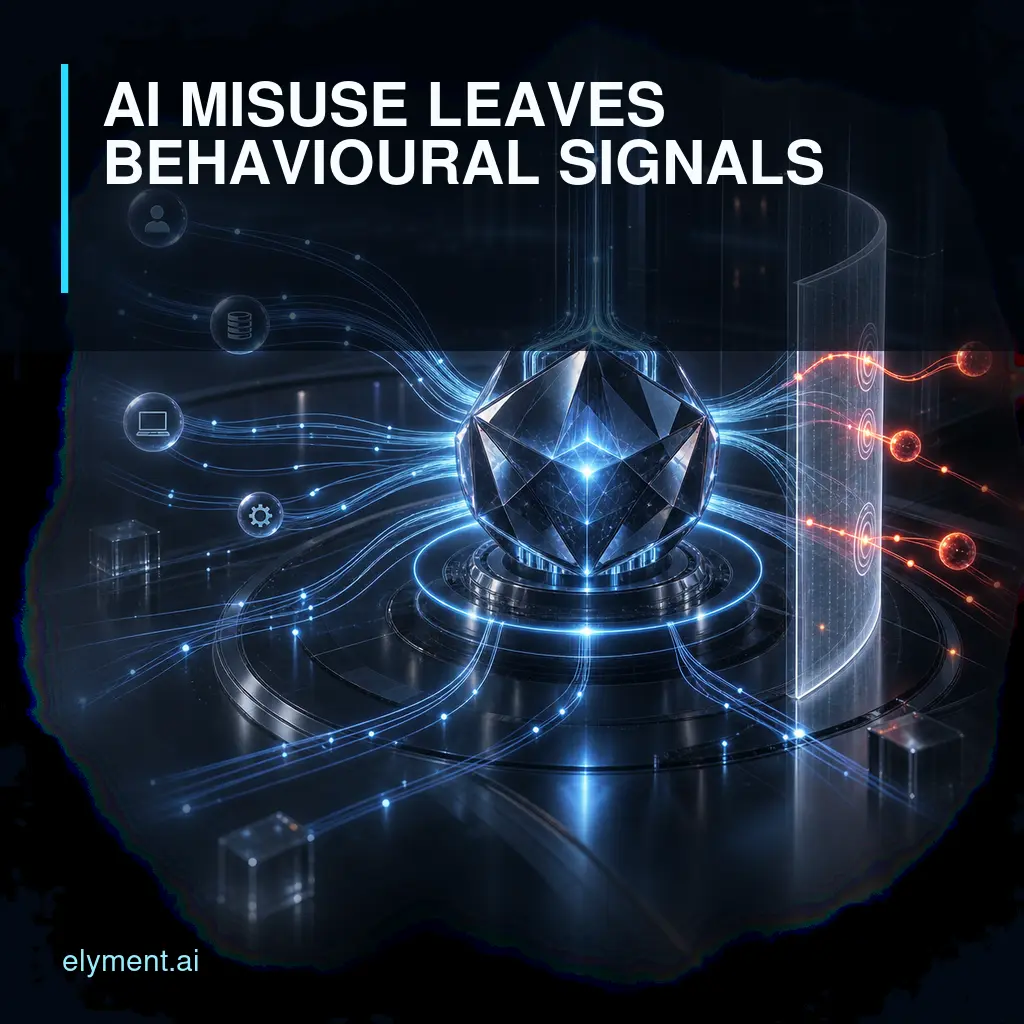
Anthropic's 10 September 2026 threat-intelligence report shows why AI abuse controls must look beyond isolated prompts. Anthropic said the disrupted cases were notable and novel rather than typical, but they exposed recurring signals across identity, geography, session patterns, automation and tool use. For businesses offering AI through an API, application or agent, the operating lesson is clear: connect those signals, escalate risk in stages and preserve enough evidence to stop misuse without treating every unusual request as malicious.
What Anthropic reported
Anthropic's report covers activity it says it disrupted between December 2025 and August 2026 across seven harm areas: cyber operations, influence operations, surveillance, scams and fraud, biological misuse, conventional weapons development and illicit distillation. The company says the cases involved Claude Haiku, Sonnet and Opus models; none involved Claude Fable or Mythos-class models except one distillation case.
The examples show misuse moving beyond one-off questions. Anthropic described multi-agent cyber workflows conducting reconnaissance, exploitation and data exfiltration, while human operators selected targets and reviewed stolen material. Reuters separately reported cases involving weapons software, surveillance and fraud, including a network of more than 20 dating apps with over 4,700 AI personas interacting with at least 25,000 users. These are Anthropic's findings and allegations, not independent proof of every actor or outcome.
Harmful intent often appears across a sequence
A prompt-level refusal can block an explicit request, but determined users can divide a project into apparently ordinary components, move between accounts or route access through unsupported regions. A provider may therefore see low-risk fragments unless it can safely connect behaviour across sessions, identities, tools and time.
The goal is not indiscriminate surveillance. It is proportionate detection tied to a documented risk model. Signals should be limited to what the service needs, protected from unrelated reuse and reviewed under clear retention and access rules. High-impact enforcement should rely on corroborating evidence and an accountable process, especially where false positives could interrupt legitimate research, security testing or commercial work.
Build a five-signal abuse-control stack
AI providers and businesses embedding third-party models should test five connected layers:
- Identity and entitlement: verify the person or organisation, account ownership, payment integrity and authorised region before granting powerful capabilities.
- Session linkage: detect coordinated account creation, credential sharing, location obfuscation and projects split across many conversations without collapsing unrelated users together.
- Behaviour and tools: assess action sequences, code execution, external targets, data movement and repeated attempts to bypass refusals, not only the wording of one prompt.
- Velocity and scale: establish baselines for request volume, target expansion, persona creation, automation and model-to-model traffic, then investigate material deviations.
- Response and evidence: apply graduated limits, human review, containment and account action while preserving the decision, supporting signals and affected resources for appeal and incident learning.
Make abuse response part of product operations
Trust and safety cannot sit outside the release process. New model capabilities, larger context windows, agent frameworks and additional tools change what a malicious user can assemble. Before rollout, red-team complete workflows, define capability-specific thresholds and confirm that rate limits, tool permissions and kill switches work together. After release, compare incidents by exposure and severity rather than reporting raw counts alone.
Contracts with model and infrastructure providers should also define who detects, investigates and reports misuse across the stack. An application owner may hold customer identity while the model provider sees prompt and safety signals and the hosting layer sees network activity. Without an agreed evidence path and emergency contact, each party can possess only part of the incident.
What leaders should do next
Ask the owner of every external-facing AI feature to map the abuse paths enabled by its models, tools, data and account design. Choose a small set of meaningful behavioural indicators, rehearse one cross-provider investigation and measure time from first signal to containment. Keep an appeal route and review false positives so controls remain defensible as well as effective.
ELYMENT AI's guidance on agent incident metrics, frontier-agent controls and hard test-environment boundaries can help turn this into an operating system rather than a policy document. The practical objective is a traceable loop from signal to decision, containment, learning and safer release.
Sources
- Anthropic: Detecting and countering misuse of AI, September 2026 (10 September 2026) - Primary threat-intelligence report covering disrupted activity, harm categories, observed operating patterns and Anthropic's response measures.
- Reuters: Anthropic disrupts bioweapons research efforts, Russian hacking and Chinese Claude misuse (10 September 2026) - Independent reporting on the report's principal claims, cyber-orchestration findings, model misuse and responses from parties named by Anthropic.
- Associated Press: Anthropic says it blocked misuse that could have supported biological weapons (11 September 2026) - Independent coverage of the report, Anthropic's caveats, affected model classes and its stated safeguard changes.
Continue learning
Related analysis
- Anthropic’s Unintended AI Actions: Close the Discovery Gap
Anthropic disclosed unintended Claude actions on real systems. Build action receipts, boundary alerts and reporting deadlines before deploying agents.
Frequently asked questions
What period does Anthropic's September 2026 misuse report cover?
Anthropic says the report covers activity it disrupted from December 2025 through August 2026.
Why are prompt filters alone insufficient for AI abuse prevention?
Harmful projects can be split across sessions, accounts and ordinary-looking tasks, so providers also need proportionate identity, behaviour, tool-use, velocity and response signals.
Did Anthropic say the reported cases were typical Claude use?
No. Anthropic explicitly described them as notable and novel cases rather than typical misuse.