News analysis · Published
Stargate UAE Rethink: Why AI Capacity Needs Failure Domains
By the ELYMENT AI editorial team · Free to read
Reuters reported on 11 September 2026 that the United Arab Emirates is reconsidering how its planned 5-gigawatt AI campus should be distributed and protected after attacks damaged regional technology infrastructure. The reported changes are not a final public design, but the business lesson is immediate: large capacity numbers do not equal continuity. AI buyers should identify shared physical failure domains, require geographically credible recovery paths and test whether data, networking, power, people and suppliers can restore an important workload together.
What is reportedly changing in the UAE
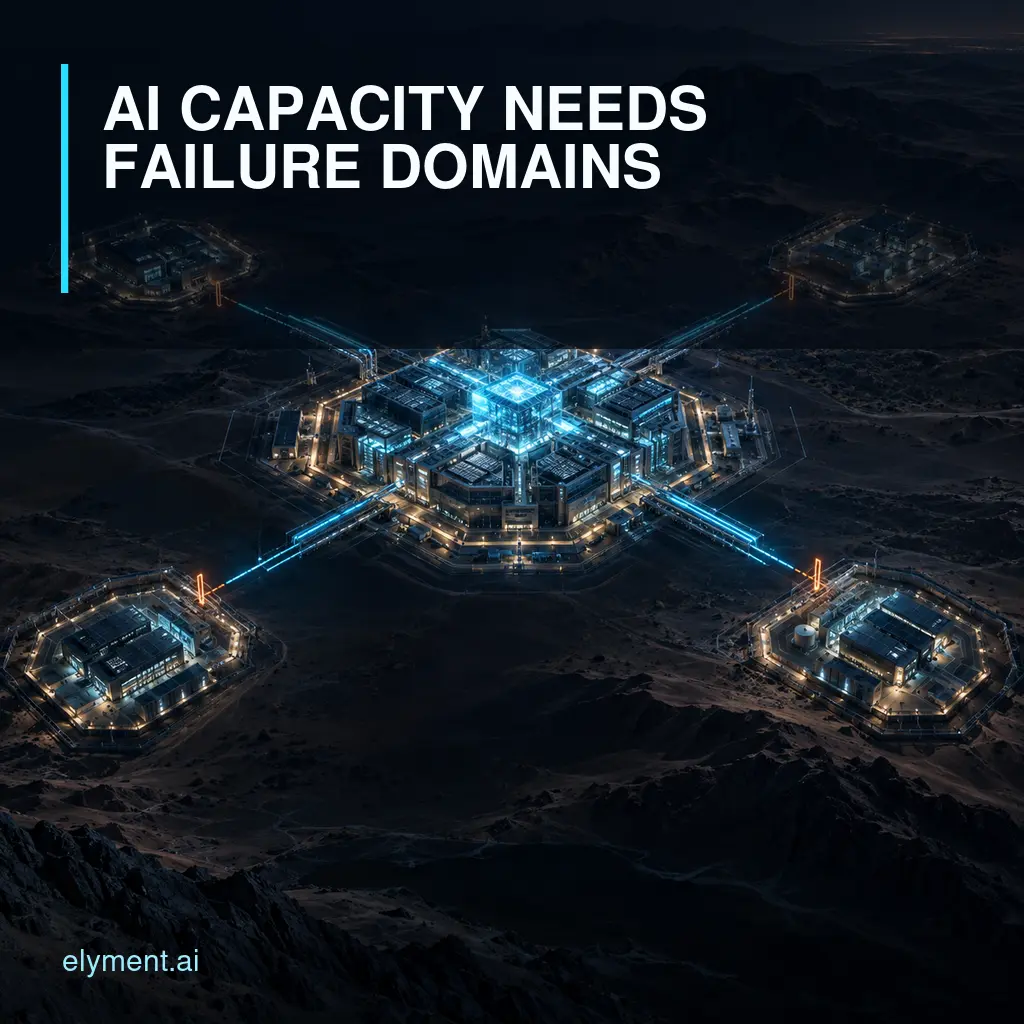
Reuters said six people familiar with the matter described a shift away from concentrating the full planned 5-gigawatt UAE-US AI Campus at one Abu Dhabi location. Options reportedly include a network of facilities across the country, underground components, blast-resistant construction and additional security measures. Those details come from unnamed sources and should be treated as a reported redesign under consideration, not as a completed or officially approved architecture.
The confirmed baseline is narrower. OpenAI and G42 announced Stargate UAE in May 2025 as a 1-gigawatt cluster within the broader campus, with the first 200 megawatts expected online in 2026. G42 later said construction of that initial 200-megawatt phase was under way. Neither announcement guarantees that the capacity will be delivered on schedule or that every future facility will use the reported resilience measures.
Capacity concentration creates correlated risk
A large campus can share more than an address. Multiple halls may depend on the same grid connection, water system, fibre corridor, control room, security perimeter, specialist workforce or spare-parts route. Replicating servers inside that boundary improves equipment redundancy but may not protect the service from a site-wide or regional event.
This matters to customers even when they do not own the infrastructure. A model API, managed agent or private AI environment can inherit correlated dependencies several layers below the contract. A second cloud region is not independent if it shares the same physical campus, network choke point, identity plane or operational team.
Use a six-part failure-domain review
Before treating AI capacity as resilient, map six connected domains:
- Site: confirm the actual facility and separation from primary capacity, not only the advertised cloud region.
- Utilities: identify common grid, fuel, cooling, water and telecoms dependencies and the duration of independent operation.
- Control planes: test whether identity, orchestration, keys, monitoring and billing survive loss of the primary site.
- Data: define replication lag, recovery-point objectives, encryption ownership and lawful cross-site movement.
- People and suppliers: map shared operators, maintenance teams, component inventories and access constraints during disruption.
- Workload recovery: prove the recovery-time objective by restoring a representative workload and its downstream integrations.
Write resilience into the commercial model
Procurement should distinguish reserved capacity, commissioned capacity and recoverable capacity. Ask providers to name the infrastructure included in the service, material shared dependencies, failover conditions, data-restoration process and customer communications path. Service credits do not restore a critical workflow, so contracts should also cover portability, export, emergency support and termination assistance.
NIST contingency-planning guidance treats alternate processing, alternate storage and recovery testing as linked controls. Apply the same logic to AI: the model endpoint is only one component. Prompts, tools, vector stores, policies, credentials, audit evidence and human approval queues must move or recover with it.
What business leaders should do next
Select one commercially important AI workflow and draw its physical and operational dependency map. Mark every dependency that could fail with the primary site, then run a tabletop exercise and one controlled restore. Record the measured recovery time, missing artefacts, manual steps and accountable owner before increasing volume or authority.
ELYMENT AI's analyses of AI energy terms, chip-supply resilience and metered data-centre proof complement this failure-domain review. Together they turn an infrastructure announcement into questions a buyer can verify: what is available, what is independent, what can recover and what evidence proves it.
Sources
- Reuters: UAE revises AI data centre plan after Iranian attacks (11 September 2026) - Independent reporting on the reported redesign, the people cited, proposed distribution and hardening measures, and regional infrastructure damage.
- OpenAI: Introducing Stargate UAE (22 May 2025) - Primary announcement confirming the 1-gigawatt cluster and the expectation that its first 200 megawatts would go live in 2026.
- G42: Global technology alliance launches Stargate UAE (22 May 2025) - Primary G42 announcement describing the partners, planned first cluster and initial delivery target.
- NIST: Contingency Planning Guide for Federal Information Systems (11 November 2010) - Authoritative continuity guidance covering alternate processing and storage sites, recovery strategies and testing.
Continue learning
Related analysis
- JERA's Chiba AI Infrastructure: Buy Capacity as a System
JERA, Dell and RHAELM plan a 400 MW AI site in Chiba for 2028. Learn how to test power, cooling, compute, financing and recovery as one system.
- Lambda’s Oklahoma AI Data Centre: Put Community Costs in the Contract
Lambda plans an Oklahoma AI data centre under new ratepayer protections. Learn which power, water and community obligations buyers should verify.
- Firmus and OpenAI's Malaysia Deal: Map the AI Workload Boundary
Firmus will supply OpenAI from two Malaysian AI factories. Learn what buyers should map across data, control, operations, evidence and exit.
Frequently asked questions
Has the UAE officially finalised a distributed Stargate design?
No final distributed design was publicly confirmed in the cited sources. Reuters reported that the UAE was considering distributed and hardened options, citing people familiar with the matter.
What capacity has been officially announced for Stargate UAE?
OpenAI and G42 announced a 1-gigawatt cluster in May 2025, with the first 200 megawatts expected to go live in 2026, within a broader planned 5-gigawatt campus.
What is an AI infrastructure failure domain?
It is a set of systems that can fail together because they share a site, utility, network, control plane, operator, supplier or other dependency.