News analysis · Published
Lambda’s Oklahoma AI Data Centre: Put Community Costs in the Contract
By the ELYMENT AI editorial team · Free to read
Lambda announced on 27 September 2026 that it plans to build an AI data centre at MidAmerica Industrial Park in Mayes County, Oklahoma. The company says it will pay its full energy costs under the state’s new ratepayer-protection law and use closed-loop cooling. The project is a useful procurement signal: AI capacity is no longer only a performance and price decision. Buyers should require auditable commitments for power infrastructure, water, local impacts, delivery milestones and exit risk before treating announced capacity as dependable supply.
What Lambda announced in Oklahoma
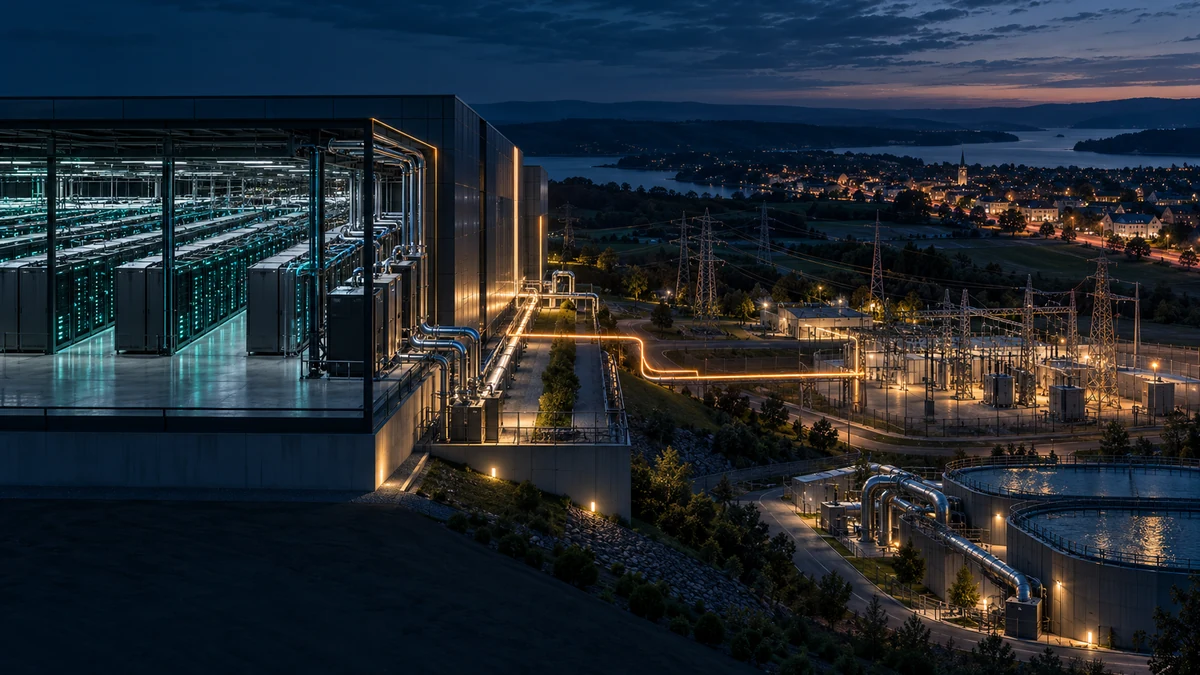
Lambda’s 27 September announcement describes a planned AI data centre in Chouteau at MidAmerica Industrial Park. The company estimates the project could generate US$500 million in taxes over 10 years, create up to 1,000 construction jobs and support up to 100 permanent positions. These are forward-looking company estimates, not realised outcomes. Lambda did not publish the facility’s capacity, commissioning date or customer allocation in the announcement.
The company says the site will use closed-loop cooling to preserve and recycle water. It also says it will pay 100 per cent of its energy costs, including the resources and infrastructure required to serve the facility, in line with Oklahoma’s Data Center Customer Ratepayer Protection Act. That law was signed in May 2026 after state legislators argued ordinary utility customers should not carry the incremental grid costs created by large data centres.
Ratepayer protection is becoming an AI procurement issue
The policy context extends beyond Oklahoma. On 16 September 2026, the US House of Representatives voted 417 to 3 for a federal Ratepayer Protection Act that would require state utility regulators to consider whether large electricity users should bear incremental infrastructure costs. Reuters noted that critics considered the proposal limited because it requires consideration rather than a universal cost-allocation rule.
For AI buyers, the implication is practical. A supplier can announce a site, GPUs or tax benefits while unresolved interconnection, transmission, water or community obligations still affect cost and timing. If those obligations later change, the buyer may face delayed capacity, pass-through charges or a stranded migration plan.
Build a capacity-cost responsibility schedule
Before signing a long-term compute commitment, attach a responsibility schedule to the capacity contract. It should identify the evidence, owner and remedy for each dependency rather than relying on a broad sustainability statement.
- Power: record the interconnection status, upgrade scope, who funds it, expected energisation date and treatment of overruns.
- Water and cooling: define the design, operating limits, measurement method, drought response and responsibility for alternative supply.
- Community obligations: identify applicable tax, employment, noise, land-use and ratepayer commitments, plus the evidence used to track them.
- Capacity delivery: separate announced megawatts from energised, tested and customer-accepted capacity with milestone-linked payments.
- Change and exit: set notice, price-adjustment, portability and termination rights if regulation, utilities or construction change the service.
What business leaders should do next
Ask the provider for the actual utility and construction milestones behind the service date, not only the campus announcement. Require a clear boundary between provider-funded infrastructure and charges that may reach customers. For critical workloads, keep a tested alternative region or supplier until the contracted capacity has passed acceptance testing.
ELYMENT AI’s earlier analysis of Google’s Finland investment explains how to test power terms; its TCS HyperVault guide separates campus ambition from metered proof; and the Stargate UAE article shows why physical failure domains matter. Apply those same disciplines here, but add a named community-cost owner.
The useful question is not whether an AI data centre sounds beneficial. It is whether every cost, dependency and delivery claim has an accountable party, measurable evidence and a contractual remedy. ELYMENT AI can help teams turn that schedule into a governed infrastructure decision rather than a headline-driven commitment.
Sources
- Lambda: New AI data centre in Mayes County, Oklahoma (27 September 2026) - Primary announcement covering location, company tax and employment estimates, cooling design and energy-cost commitments.
- Oklahoma House of Representatives: Data Center Consumer Ratepayer Protection Act (6 May 2026) - Official legislative explanation of the state measure intended to protect ordinary utility customers from incremental data-centre costs.
- KOSU: Oklahoma ratepayer protection bill signed (15 May 2026) - Independent Oklahoma reporting on the enacted law and its intended utility-cost protections.
- Reuters: US House advances data-centre Ratepayer Protection Act (16 September 2026) - Independent reporting on the 417-to-3 House vote, federal scope and criticism that the measure requires consideration rather than a universal rule.
Continue learning
Related analysis
- JERA's Chiba AI Infrastructure: Buy Capacity as a System
JERA, Dell and RHAELM plan a 400 MW AI site in Chiba for 2028. Learn how to test power, cooling, compute, financing and recovery as one system.
- Stargate UAE Rethink: Why AI Capacity Needs Failure Domains
The reported Stargate UAE redesign shows why AI data-centre strategy needs distributed failure domains, tested recovery and resilient supplier contracts.
- Firmus and OpenAI's Malaysia Deal: Map the AI Workload Boundary
Firmus will supply OpenAI from two Malaysian AI factories. Learn what buyers should map across data, control, operations, evidence and exit.
Frequently asked questions
What did Lambda announce in Oklahoma?
Lambda announced a planned AI data centre at MidAmerica Industrial Park in Mayes County, with closed-loop cooling and a commitment to pay its energy costs under Oklahoma’s ratepayer-protection law.
Is the Lambda Oklahoma data centre operating?
No operating date or commissioned capacity was stated in the 27 September announcement. It is a planned project, and the tax and job figures are company estimates.
What should an AI capacity contract verify?
It should allocate power, grid-upgrade, water, community and construction costs; define tested delivery milestones; and provide price, portability and exit remedies.