News analysis · Published
ChatGPT for Financial Services: Build an Evidence Chain
By the ELYMENT AI editorial team · Free to read
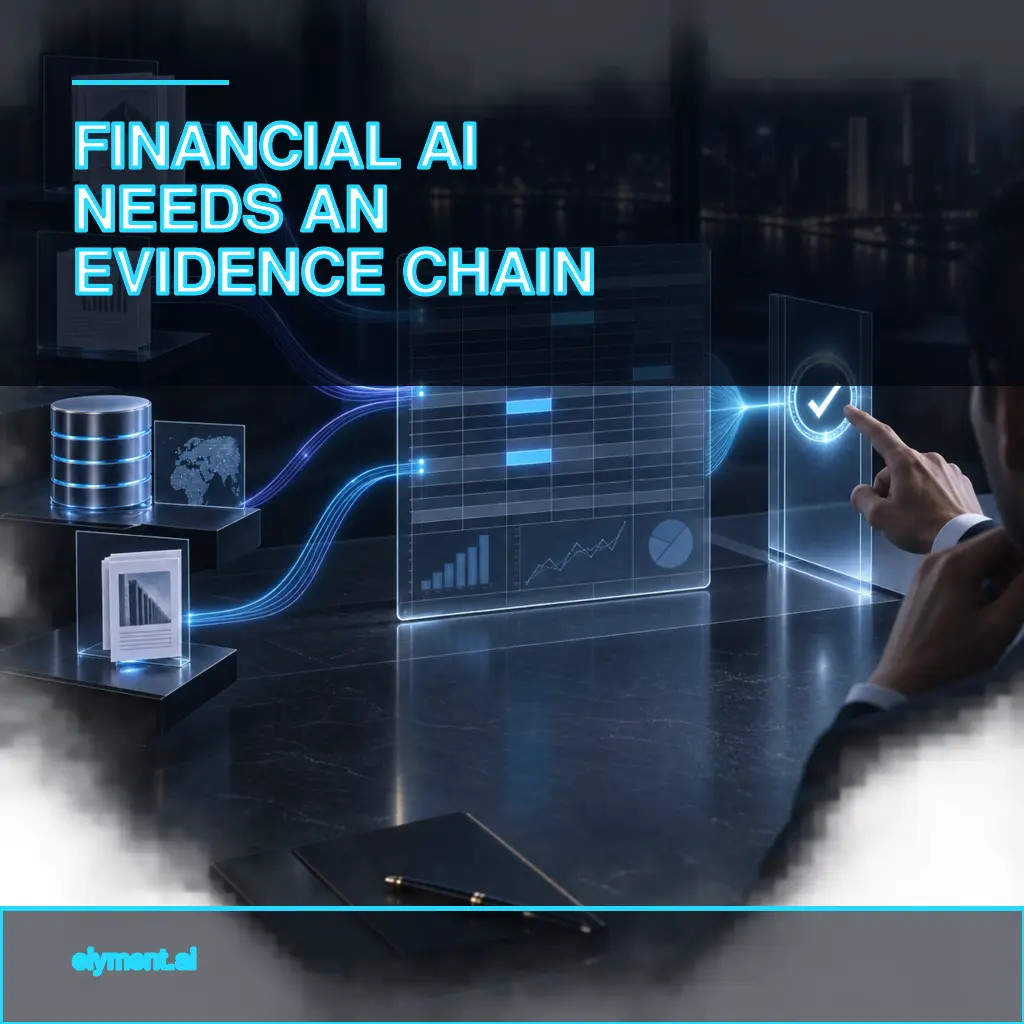
OpenAI launched ChatGPT for Financial Services on 10 September 2026, combining GPT-6 Astra with built-in financial datasets, existing subscription connections, firm templates and enterprise controls. The product is designed for investment banking and equity research work such as research, modelling and pitchbook preparation. For business leaders, the important change is not simply a finance-specific chatbot. It is the consolidation of licensed data, analysis and finished work inside one AI workspace. Firms should preserve an evidence chain from entitlement and source through transformation, review and release.
What OpenAI launched
OpenAI said on 10 September that ChatGPT for Financial Services is available to eligible financial institutions. Morgan Stanley and Evercore served as design partners. The initial focus is investment banking and equity research, with built-in datasets from providers including Daloopa, PitchBook, LSEG News and Crunchbase covering earnings transcripts, financial statements, company fundamentals and private-company information.
The product also supports shared sign-in and entitlement work with providers including S&P Capital IQ, LSEG, MSCI, Dow Jones Factiva and Moody's. OpenAI says GPT-6 Astra can retrieve information, interpret financial documents and create spreadsheets, documents and slides. Administrators can publish firm templates, manage role-based access and data connections, configure retention, create separate workspaces and export supported logs through the OpenAI Compliance Platform.
Why integrated data changes the control problem
A finance-specific workspace can remove several hand-offs between a data terminal, spreadsheet, presentation tool and general AI assistant. That may reduce friction, but it also concentrates responsibility. One workspace can now retrieve a licensed figure, transform it, place it in a model and carry it into client material.
A citation helps a reviewer find a source. It does not by itself prove that the user was entitled to access the data, that the correct period and definition were selected, that the transformation was valid, or that the final document reflects current approval. Those questions belong to an evidence chain that joins access, source, calculation and release.
Use a five-link evidence chain
Before accepting AI-assisted financial work, require five connected records:
- Entitlement: record the user, workspace, provider, dataset and licence basis that permitted access at the time of retrieval.
- Source: retain the exact table, passage, date, currency, period, definition and retrieval time behind each material figure or claim.
- Transformation: preserve formulas, assumptions, adjustments, model version and the path from source values to calculated outputs.
- Review: name the accountable reviewer, the checks performed, exceptions resolved and the version that received approval.
- Release: bind the approved evidence to the final spreadsheet, research note, pitchbook or client communication so later edits are visible.
Test the workflow, not only the answer
Run representative cases before broad deployment. Include restated accounts, conflicting provider values, mixed currencies, stale filings, unavailable subscription data, footnote adjustments and a source that changes after the first draft. The workflow should surface the conflict, preserve the original evidence and stop release when review conditions are not met.
Measure citation coverage, unsupported material claims, formula changes, review time, exception rate and approved-output accuracy. Do not treat a polished model or presentation as proof that the underlying chain is complete.
What financial leaders should do next
Choose one bounded workflow, such as earnings analysis or buyer screening, and map every material output back through the five links. Ask legal and procurement teams to confirm data rights, security teams to test workspace boundaries, and finance leaders to define which decisions still require named approval.
ELYMENT AI's analyses of GPT-6 Astra monitoring, frontier-AI financial resilience and outcome-based AI contracts extend the same discipline across observable actions, recovery and commercial accountability. ELYMENT AI can help turn the evidence chain into an acceptance test and operating register for a specific financial workflow.
Sources
- OpenAI: Introducing ChatGPT for Financial Services (10 September 2026) - Primary announcement covering availability, design partners, datasets, entitlement integrations, GPT-6 Astra capabilities, templates and enterprise controls.
- Reuters: OpenAI launches ChatGPT for the financial services industry (10 September 2026) - Independent reporting on the product launch, target users, data providers, design partners and planned expansion across financial services.
- Business Insider: OpenAI expands ChatGPT's financial data and citations (10 September 2026) - Independent reporting on integrated datasets, granular citations and the product's place in OpenAI's industry-specific enterprise strategy.
Continue learning
Related analysis
- ChatGPT's EU Search Designation: What Businesses Should Prepare For
ChatGPT is now an EU very large online search engine under the DSA. Businesses should prepare vendor evidence, contract terms and governance for AI search.
- FSB's AI Cyber Warning: What Financial Firms Should Test
The FSB says frontier AI could amplify cyber risk across finance. Firms should test provider concentration, response and bare-metal recovery now.
Frequently asked questions
What is ChatGPT for Financial Services?
It is a tailored ChatGPT Work product for eligible financial institutions that combines GPT-6 Astra, built-in financial datasets, existing subscription connections, firm templates and enterprise controls.
Which work does it initially target?
OpenAI says the initial focus is investment banking and equity research, including research, financial modelling, buyer screening, earnings analysis and pitchbook preparation.
Are citations enough to approve AI-generated financial work?
No. A firm should also verify data entitlement, source context, calculations and assumptions, accountable review and the exact final version released.