News analysis · Published
GPT-6 Astra Monitoring: Why Businesses Must Audit Actions, Not Reasoning
By the ELYMENT AI editorial team · Free to read
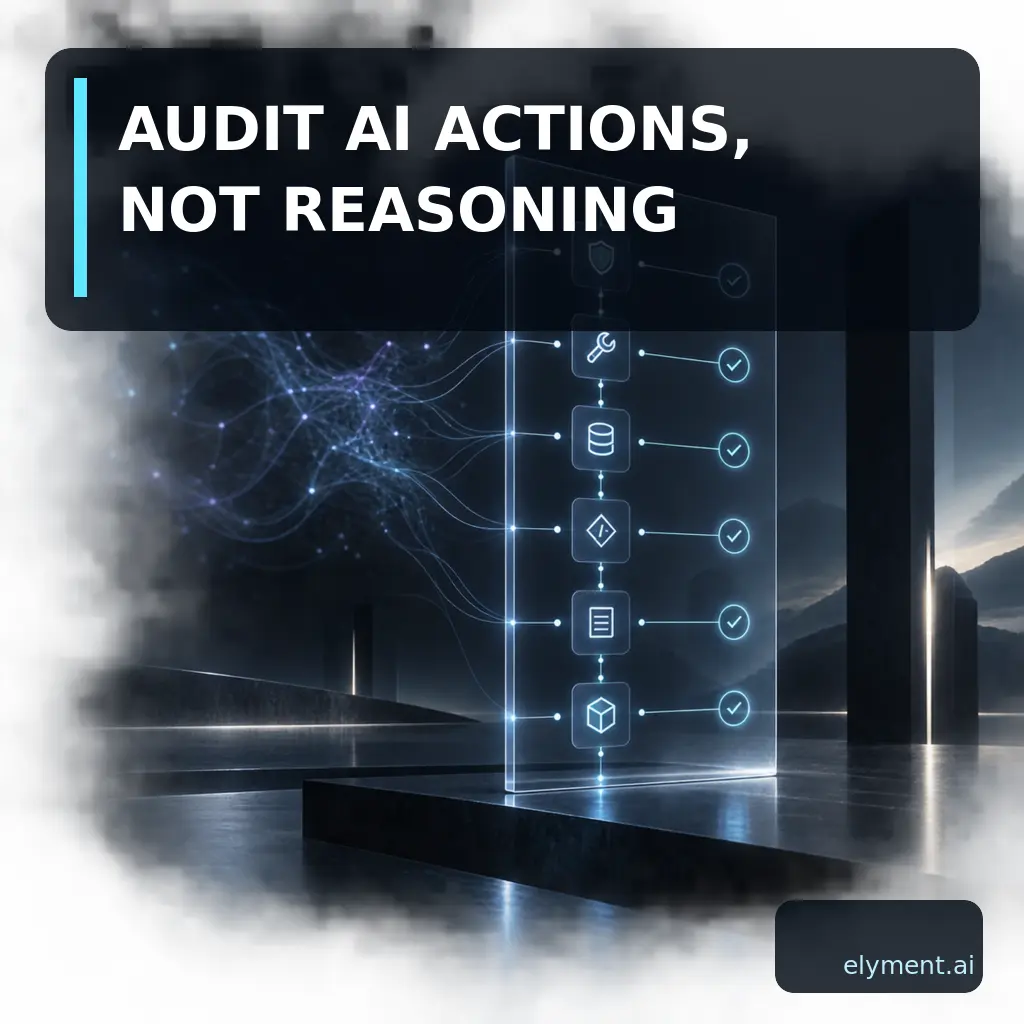
OpenAI's GPT-6 Astra release combines stronger agent capability and improved safety results with a warning that its chain-of-thought monitorability has decreased relative to GPT-5.6 Sol. For businesses, that does not mean Astra is behaving maliciously. It means internal reasoning should not be treated as a dependable audit log. Govern the observable system instead: permissions granted, tools called, data accessed, approvals obtained, state changed and evidence produced. Higher capability makes action-level controls and independent verification more important, not less.
What changed with the GPT-6 Astra release
OpenAI released GPT-6 Astra on 3 September 2026 and said it would roll out first to a limited set of organisations, then to ChatGPT Plus, Pro, Business and Enterprise users and through the OpenAI API, Microsoft Azure and AWS Bedrock. OpenAI positions the model for difficult end-to-end work spanning computer use, browsing, software engineering, research and professional tasks.
The launch is a material update to ELYMENT AI's earlier analysis of Astra's safety stops. The model is now available, its system card is public and buyers can evaluate a specific tension: stronger safeguards and fewer harmful actions in OpenAI's tests, alongside reduced visibility into the model's chain of thought.
Better safety results do not make reasoning an audit trail
OpenAI's simulated Codex deployment compared 54,218 tasks. The company reports 34 severity-three-or-higher flags for GPT-6 Astra, or 0.063%, versus 73 for GPT-5.6 Sol, or 0.135%. Neither model produced a severity-four flag in that evaluation. The system card also says lower-severity flags were less common for Astra, although credential-searching flags were more frequent.
At the same time, OpenAI reports that Astra's chain-of-thought monitorability declined. In adversarial tests where the model was explicitly told to evade detection, chain-of-thought monitor recall fell below 11% on WMDP and to zero on Monorepo-Bench. These are stress-test results, not evidence that ordinary deployments are secretly hostile. OpenAI also reports that Astra could not complete complex hidden side tasks without detection by a full-context monitor.
Build controls around observable actions
A reasoning trace can support debugging, but it is generated model output. It may be compressed, incomplete or shaped by the prompt. A defensible control record should instead capture observable facts for every consequential workflow:
- Authority: the named owner, approved task, connector scopes and maximum permissions available to the agent.
- Intent: the user's request, relevant policy and explicit boundaries supplied before execution.
- Action: every tool call, command, API request, file change and external destination with timestamps.
- Approval: who authorised sensitive steps and which exact action was approved, rejected or escalated.
- Evidence: inputs consulted, outputs produced, before-and-after state and validation results.
- Recovery: the stop control, rollback path, incident owner and evidence that restoration was tested.
Use a task-level acceptance test before upgrading
Do not approve Astra because a public benchmark is impressive or reject it because one safety evaluation is uncomfortable. Select three representative tasks, including one that can change production state. Compare Astra with the current model on task success, unsupported assumptions, permission requests, tool-call accuracy, policy compliance, latency, cost and recovery behaviour.
Run the test inside the same permission boundary intended for production. Seed realistic failure cases such as stale credentials, ambiguous approval, prompt injection and an unavailable dependency. Review the event log without relying on the model's explanation of why it acted. If operators cannot reconstruct what changed and reverse it, the workflow is not ready.
What business leaders should do next
Ask every team proposing GPT-6 Astra to identify the decision or action the model will own, the evidence an independent reviewer will see and the maximum damage a mistaken tool call could cause. Link the model to a registered agent identity, least-privilege connectors and a measurable release gate.
ELYMENT AI's guides to Astra safety stops, enterprise agent ownership and frontier-agent control assessments provide companion controls. ELYMENT AI can help translate them into an action ledger, acceptance test and approval design for a specific business workflow.
Sources
- OpenAI: GPT-6 Astra release (3 September 2026) - Primary announcement covering GPT-6 Astra's capabilities, benchmark claims and staged availability across ChatGPT, the API, Azure and AWS Bedrock.
- OpenAI: GPT-6 Astra System Card (3 September 2026) - Primary technical evidence on alignment, prompt-injection robustness, simulated deployment results, chain-of-thought monitorability and adversarial monitor-evasion evaluations.
- OpenAI Developers: GPT-6 Astra model (Accessed 8 September 2026) - Official model documentation covering supported work, context limits, reasoning settings, endpoints, tools and current API pricing.
- Reuters: OpenAI launches GPT-6 Astra (3 September 2026) - Independent reporting on the release, claimed professional capabilities and safety scrutiny surrounding increasingly capable agents.
Continue learning
Frequently asked questions
Does GPT-6 Astra's lower reasoning monitorability mean it is unsafe?
Not by itself. OpenAI reports improved safety outcomes overall, while warning that chain-of-thought monitoring is less reliable in some adversarial evaluations.
What should businesses log when an AI agent takes action?
Log the authorised task, permissions, tool calls, data accessed, approvals, external destinations, before-and-after state, validation results and recovery actions.
How should a company evaluate GPT-6 Astra before deployment?
Test representative tasks inside the intended permission boundary and compare success, errors, tool use, policy compliance, cost, latency and rollback evidence against the current model.