News analysis · Published
AWS Agent Registry: What Enterprise Agent Governance Still Needs
By the ELYMENT AI editorial team · Free to read
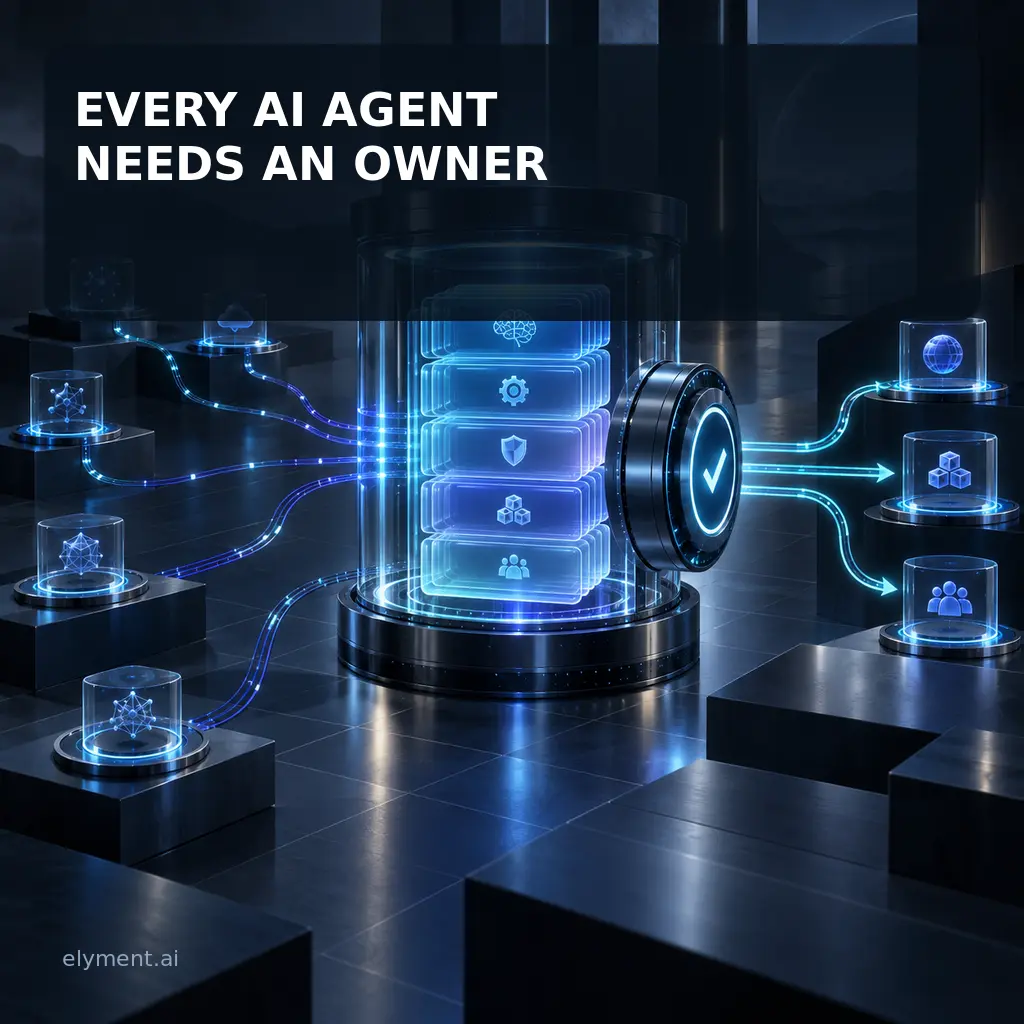
AWS Agent Registry became generally available on 31 August 2026 as a private catalogue for agents, tools, skills, Model Context Protocol servers and custom resources. It can give an enterprise a searchable record of what exists, who owns it and what has passed approval. It does not prove that an agent is safe at runtime, that its underlying data is current or that its output is accurate. Businesses should treat registration as the start of governance, not the final control.
What AWS made generally available
AWS says Agent Registry can be accessed through its console, command-line interface and software development kits, as well as from Amazon Bedrock AgentCore, Amazon Quick and Kiro. The service supports semantic and keyword search, approval workflows, AWS CloudTrail audit trails, infrastructure-as-code management, tagging, cross-account sharing and organisation-wide auto-detection of agents running on AgentCore infrastructure.
At launch, AWS listed five supported regions: US West (Oregon), Asia Pacific (Tokyo), Asia Pacific (Sydney), Europe (Ireland) and US East (N. Virginia). The developer documentation also says support for the public-preview bedrock-agentcore namespace will end on 17 September 2026, making migration an immediate task for preview users.
A catalogue solves visibility, not behaviour
AWS separates a governance plane, which records resources across lifecycle states, from a discovery plane that presents only resources clearing an organisation's approval threshold. That is useful architecture: builders should find approved capabilities instead of rebuilding an unreviewed connector or agent in isolation.
Approval still has a narrow meaning. Schema validation can confirm that an MCP server or agent description is structurally valid. A record can document ownership, version and review status. Neither test shows whether an agent will respect permissions during execution, whether the business data behind it remains correct or whether a later dependency change altered its risk. Independent analysis from Atlan makes the same distinction between a governed record and accurate operating context.
Define the minimum agent record
Before making any agent discoverable, require a complete operating record:
- Purpose and owner: the business outcome, accountable operator, support contact and review date.
- Technical identity: agent, model, prompt, tools, skills, data sources and dependency versions.
- Authority: permitted users, data classifications, read and write scopes, approval gates and prohibited actions.
- Evidence: representative evaluations, security review, known limitations, incident history and acceptance threshold.
- Operations: cost centre, service level, telemetry, kill switch, fallback, rollback and retirement conditions.
Connect registry events to real controls
A useful registry is wired into delivery and operations. A new or changed record should trigger security, privacy and business-owner review. Deployment systems should block unapproved versions. Runtime gateways should enforce identity and tool scope. Monitoring should compare observed actions with declared capabilities, while incidents should trace back to an owner and exact version.
Retirement matters as much as approval. Mark stale resources as deprecated, remove discovery access, revoke credentials and confirm that dependent workflows have migrated. Otherwise the catalogue becomes a well-organised list of abandoned risk.
What business leaders should do next
Ask for an inventory of every production agent, MCP server, tool and reusable skill, then sample it against cloud accounts, gateways and code repositories to find shadow deployments. Set one minimum record, one approval route and one retirement process across the estate, even if different platforms host the underlying agents.
ELYMENT AI's guides to agent approvals, incident reporting and frontier-agent controls provide the surrounding operating framework. ELYMENT AI can help teams turn a registry into an accountable system of record linked to deployment, runtime evidence and business outcomes.
Sources
- AWS: Agent Registry is now generally available (31 August 2026) - Primary announcement covering general availability, supported resource types, search, enterprise features, integrations and five launch regions.
- AWS: Manage agents, tools and skills at scale (31 August 2026) - Primary technical account of the governance and discovery planes, lifecycle, approval, access-control and enterprise operating patterns.
- AWS documentation: Agent Registry key capabilities (Accessed 7 September 2026) - Official documentation for supported record types, schema validation, search and the 17 September preview-namespace retirement date.
- Atlan: What AWS Agent Registry governs and what it does not (1 September 2026) - Independent vendor analysis distinguishing registry approval from runtime security and the accuracy of an agent's operating context.
Continue learning
Related analysis
- Kore.ai Autoloop: Put a Change Gate Around Self-Improving Agents
Kore.ai’s Autoloop can optimise agents continuously. See the change controls businesses need for evidence, approvals, canaries and rollback.
Frequently asked questions
What is AWS Agent Registry?
It is a private AWS catalogue and discovery service for agents, tools, skills, MCP servers and custom resources, with approval, search, access-control and audit capabilities.
Does an approved registry record mean an AI agent is safe?
No. Approval records identity, metadata and review status. Runtime permissions, data quality, behaviour monitoring, evaluation and incident response remain separate controls.
What should every enterprise AI agent record include?
Include its purpose, accountable owner, versions, tools, data sources, permissions, approval gates, evaluations, known limits, telemetry, fallback and retirement conditions.