News analysis · Published
Mistral's €3 Billion Raise: How Buyers Should Test Sovereign AI
By the ELYMENT AI editorial team · Free to read
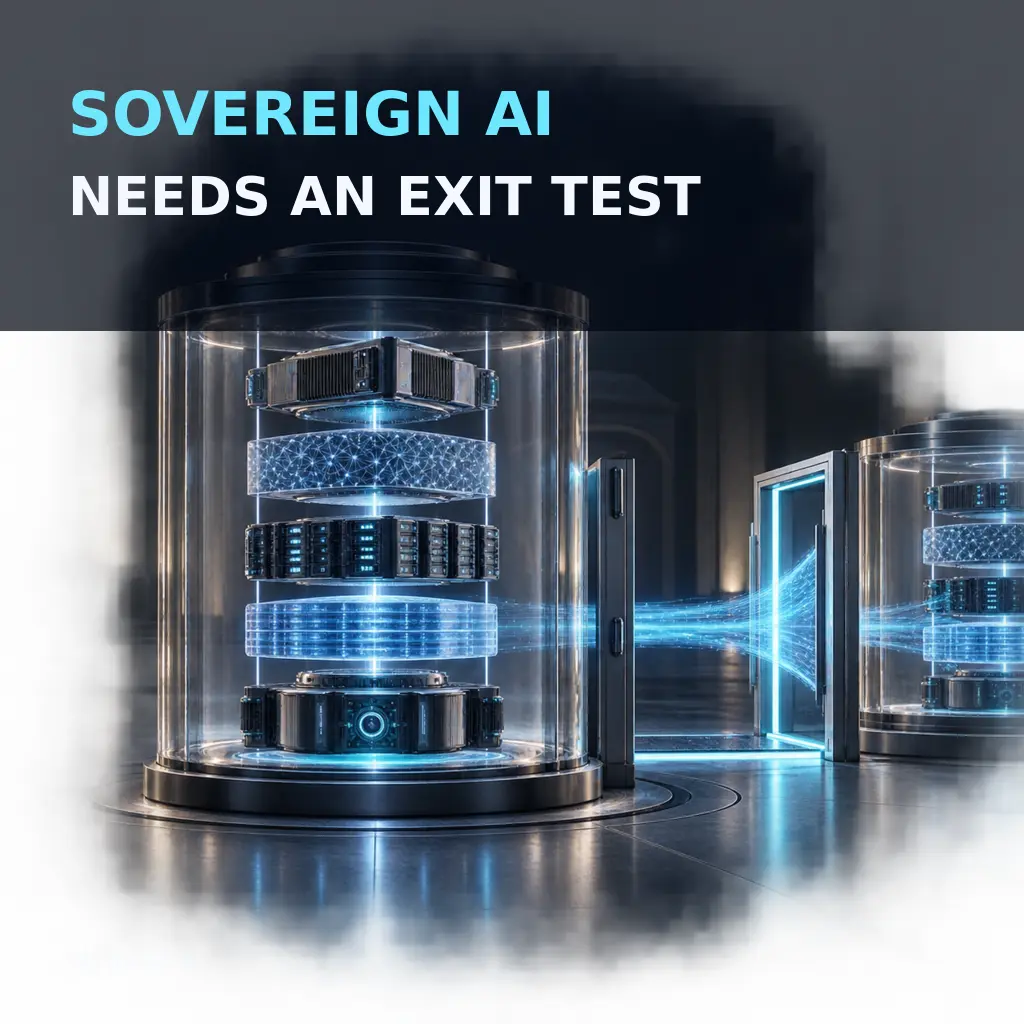
Mistral announced on 8 September 2026 that it raised €3 billion in a Series D at a post-money valuation above €21 billion. The company says the capital will expand frontier research, compute, infrastructure and international growth around sovereign, open-weight AI. For buyers, the announcement strengthens Mistral's capacity story but does not prove sovereignty for a specific workload. Treat sovereignty as an operating property: verify where data and controls sit, which components can move, what evidence is available and whether an exit works before production dependence grows.
What Mistral announced
Mistral said Samsung Electronics led the Series D, with the Scaleup Europe Fund managed by EQT and existing investor PSG Equity as co-leads. The company described the €3 billion round as the largest equity fundraising completed by a European technology company and said it now operates across 20 countries while supporting more than 125 global enterprises. Reuters independently reported the financing and valuation on 8 September.
The funding is intended to expand model research, training compute, infrastructure, products and commercial reach. Mistral presents this vertically integrated stack as a sovereign AI layer spanning data, controllable models, private and predictable compute, and auditable production systems. Those are useful design goals, but they remain provider claims until a buyer maps them to a particular service, deployment and contract.
Open weights are valuable, but they are not the whole exit
An open-weight model can give a company more deployment choice than an API-only service. Mistral also offers self-hosting, its own EU-hosted cloud and access through major cloud providers. That breadth can reduce one form of dependency, yet the production application may still rely on proprietary orchestration, fine-tuning pipelines, safety policies, identity systems, monitoring, vector stores or support processes.
Sovereignty therefore cannot be reduced to model weights or a European server address. A portable model with non-portable prompts, evaluation data and workflow state can still leave a business locked in. Conversely, a managed service may be acceptable when its data boundary, operational control and exit duties are explicit and tested.
Use a four-part sovereignty test
Before calling any AI deployment sovereign, ask the provider and internal owner to evidence four properties:
- Control: identify the legal entities, administrators, keys, policies and approval paths that can change or access the system.
- Location: document where prompts, files, embeddings, fine-tuning data, telemetry, backups and support access are processed.
- Portability: export model artefacts, prompts, evaluation sets, agent definitions, logs and workflow state into documented formats.
- Continuity: run the workload in an alternate environment, measure the quality and operational gap, then verify deletion from the original service.
Buy evidence, not a sovereignty label
Translate each property into acceptance evidence. Useful items include an architecture diagram signed by the relevant parties, a current subprocessors list, administrator-access records, a model and licence register, export documentation, reproducible evaluations, recovery objectives and a deletion certificate. A procurement clause matters only if operators can collect the evidence during normal service and after a change.
Set retest triggers for a new model version, hosting region, subprocessor, licence, control plane or major price change. Mistral's new funding may make its platform more capable and durable, but it can also accelerate product and infrastructure change. Governance should track the service that is actually running, not the version described when the contract was signed.
What business leaders should do next
Choose one representative workload and run a small exit exercise before expanding volume. Export the artefacts, deploy the closest available substitute, test quality and latency, reconstruct the audit trail and measure the time and skills required. Record any component that cannot move as an accepted dependency with an owner and contingency.
ELYMENT AI's guides to workload boundaries, open-model routing and private AI deployment provide related decision tests. ELYMENT AI can help turn those principles into a vendor scorecard, evidence register and repeatable exit drill for a specific AI portfolio.
Sources
- Mistral: €3 billion Series D announcement (8 September 2026) - Primary announcement covering the round, investors, post-money valuation, intended use of funds, international footprint and Mistral's definition of sovereign AI.
- Reuters: Mistral reaches €21 billion valuation (8 September 2026) - Independent reporting on the financing, investor group, valuation, expansion plans and Mistral's technology-sovereignty strategy.
- Mistral: deployment and portability options (Accessed 8 September 2026) - First-party description of self-hosted, Mistral Cloud and third-party cloud deployment options, plus claimed portability and control features.
- Financial Times: record European technology funding round (8 September 2026) - Independent reporting on the record-sized round and the competitive context for European AI capability.
Continue learning
Frequently asked questions
How much did Mistral raise in September 2026?
Mistral announced a €3 billion Series D on 8 September 2026 at a post-money valuation above €21 billion.
Does an open-weight model guarantee AI sovereignty?
No. Open weights can improve deployment choice, but data, control systems, workflow state, operations and contract terms also determine practical sovereignty.
What is an AI exit test?
It is a controlled exercise that exports required artefacts, runs the workload in an alternate environment, checks quality and recovery, and verifies deletion from the original service.