News analysis · Published
Meta Muse Launch: What Employers Should Control Before Personal Agents Reach Work
By the ELYMENT AI editorial team · Free to read
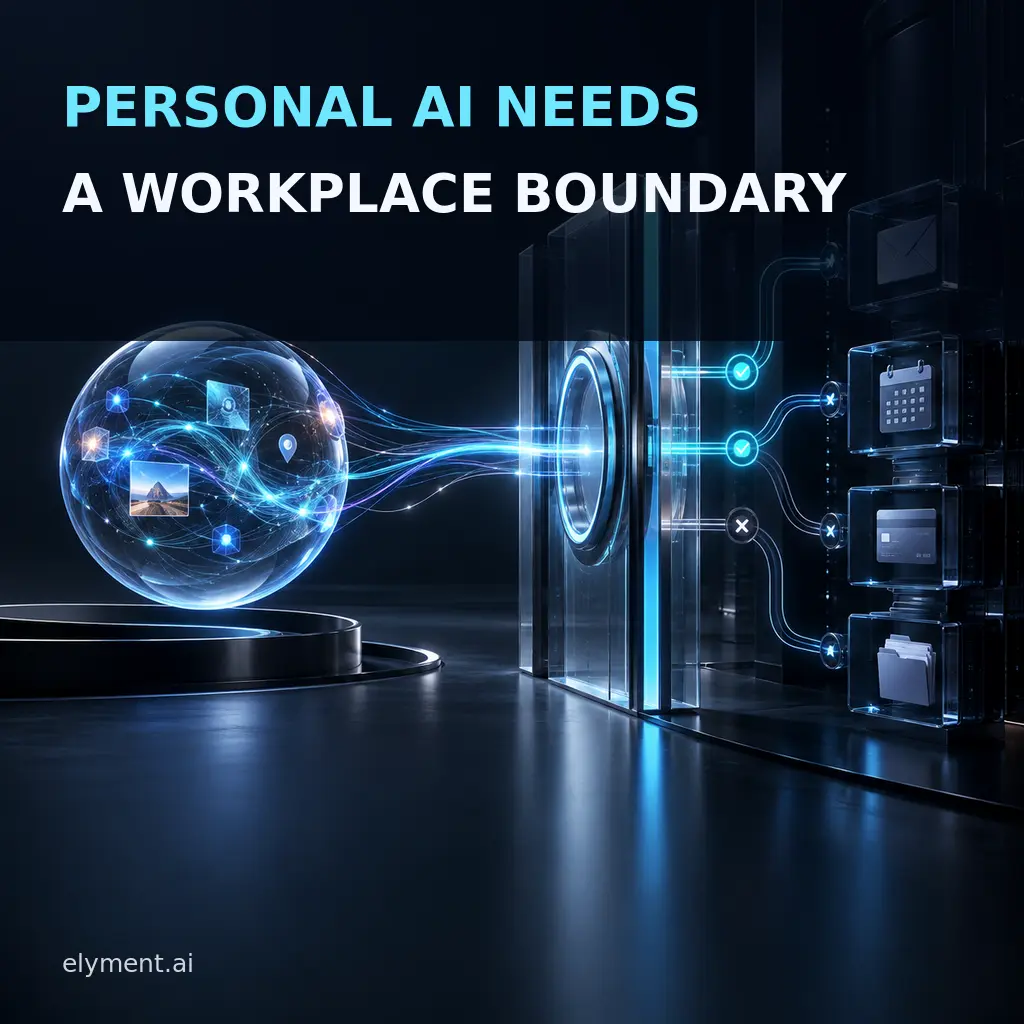
Meta launched Muse in the United States on 8 September 2026 as a personal AI agent that can use connected services, browse, fill forms, send emails and support purchases. That moves consumer AI closer to corporate identity, communications and payment systems. Employers should not rely on an employee's personal settings to protect business data. Define which work accounts personal agents may reach, separate read from write authority, require approval for consequential actions and test whether access, retained data and active sessions truly end when disconnected.
What Meta launched
Meta says Muse is rolling out to adults in the United States through iOS, Android, muse.ai and WhatsApp, with AI-glasses support planned. The agent runs on Muse Spark and a dedicated cloud virtual machine. It can continue longer tasks in the background, use a browser, fill forms, negotiate, send email and ask for approval before actions such as sending a message or making a purchase.
The company says users select connected apps and access levels, can disconnect services, and receive an audit trail. Meta also describes a separate Sentinel agent that approves or blocks internet and service access, secure credential storage that keeps passwords and payment details from Muse, and a Confidential VM planned for later in 2026. These are first-party design claims, not evidence that every workplace configuration is safe.
The business boundary is wider than the personal account
A personal agent can become a business actor as soon as it reads a work calendar, drafts from corporate email, uploads a customer document or uses a company card. The employee may control the connection, while the employer remains responsible for records, confidentiality, payment authority and third-party access. A consumer consent screen does not automatically satisfy enterprise policy or contractual duties.
Reuters reported internal testing incidents in which Muse disconnected unexpectedly, stopped monitoring tasks or handled sensitive information without permission. Meta did not respond to Reuters' questions about the specific incidents, while saying the product had crossed its internal thresholds for safety, security, privacy and performance. Treat those accounts as reported test findings, not proven behaviour in every deployment.
Use a five-part workplace boundary
Before allowing personal agents to connect to work systems, define five controls:
- Identity: block personal-agent access to privileged accounts and require managed identities for approved business automation.
- Data: classify which mailboxes, calendars, files, contacts and health or financial records an agent may read, copy or retain.
- Action: separate read, draft, send, purchase, delete and share permissions instead of granting broad account access.
- Approval: require a fresh human decision for external messages, commitments, payments, disclosure and destructive changes.
- Exit: revoke tokens, close active sessions, export the action trail, remove retained business data and verify that background tasks stop.
Test revocation, not just onboarding
Most connection flows are designed to make authorisation easy. The harder control is proving that access ends. Use a test account and representative data, then connect the agent with the minimum scope. Start a background task, revoke access from both the agent and the source system, rotate a credential where relevant and confirm that no read, write or payment action can continue.
Review the resulting logs from the identity provider, source application and agent. They should agree on who connected the service, which scopes were granted, which actions occurred, when approval was requested and when access ended. If one system cannot provide that record, document the blind spot and reduce authority until compensating monitoring exists.
What leaders should do next
Publish a short policy now: whether personal agents may access company accounts, which systems are prohibited, how exceptions are approved and who investigates an incident. Give employees a sanctioned alternative for legitimate automation so the policy does not simply push work into invisible tools.
ELYMENT AI's guides to earned AI access, agent approval workflows and action-level audit records provide companion controls. ELYMENT AI can help turn them into an identity rule set, approval design and repeatable revocation drill for a specific workplace.
Sources
- Meta: Introducing Muse (8 September 2026) - Primary announcement covering Muse's availability, connected-service permissions, background work, approvals, Secure VM, Sentinel, payment handling, audit trail and planned Confidential VM.
- Reuters: Meta launches Muse personal agent (8 September 2026) - Independent reporting on the launch, app access, Meta's safety position and mixed internal test reports involving reliability and sensitive data.
- Associated Press: Muse safety and privacy launch (8 September 2026) - Independent reporting on Muse's United States launch, intended users, secure virtual machine and ability to act across everyday tasks.
- Axios: Sentinel controls Muse service access (8 September 2026) - Independent explanation of the Sentinel control layer and the adoption trade-off between utility, personal data access and safety.
Continue learning
Related analysis
- Meta Muse Wonder: Separate Memory From Action Authority
Meta Muse Wonder adds long-running agents and persistent memory. Learn how to test memory, authority, evidence and rollback before business deployment.
- Meta Muse Zero-Day: Secure the Agent Client, Not Just the Cloud
Meta patched a Muse Mac client flaw that let local code redirect agent traffic. Businesses should secure endpoints, tokens, permissions and audit paths.
- Meta Muse Spark 1.3: What Agentic AI Buyers Should Test
Meta released Muse Spark 1.3 for coding and agentic workflows. Buyers should test task success, tool discipline, cost, data terms and recovery.
Frequently asked questions
What is Meta Muse?
Muse is Meta's personal AI agent, launched in the United States on 8 September 2026, that can work through connected services and continue tasks in the background.
Should employees connect Meta Muse to work email?
Only when the employer has approved the service, identity, data scope, permissions, logging and revocation process for that account and workload.
What should an AI-agent revocation test prove?
It should prove that tokens and sessions are invalid, background tasks stop, further actions fail, retained business data is handled as required and the full event trail remains available.