News analysis · Published
NVIDIA PAIR: What Businesses Should Test Before Pooling Local AI Compute
By the ELYMENT AI editorial team · Free to read
NVIDIA released the PAIR beta on 3 September 2026 as open-source software that routes independent AI inference requests across compatible computers on one local network. It can give multi-agent workflows more local capacity without changing their Ollama or LM Studio interfaces. It does not merge GPU memory or split one model across machines. For businesses, PAIR is a useful pilot option, not a ready-made enterprise cluster: network trust, device ownership, model governance, support, energy and measurable throughput still need validation.
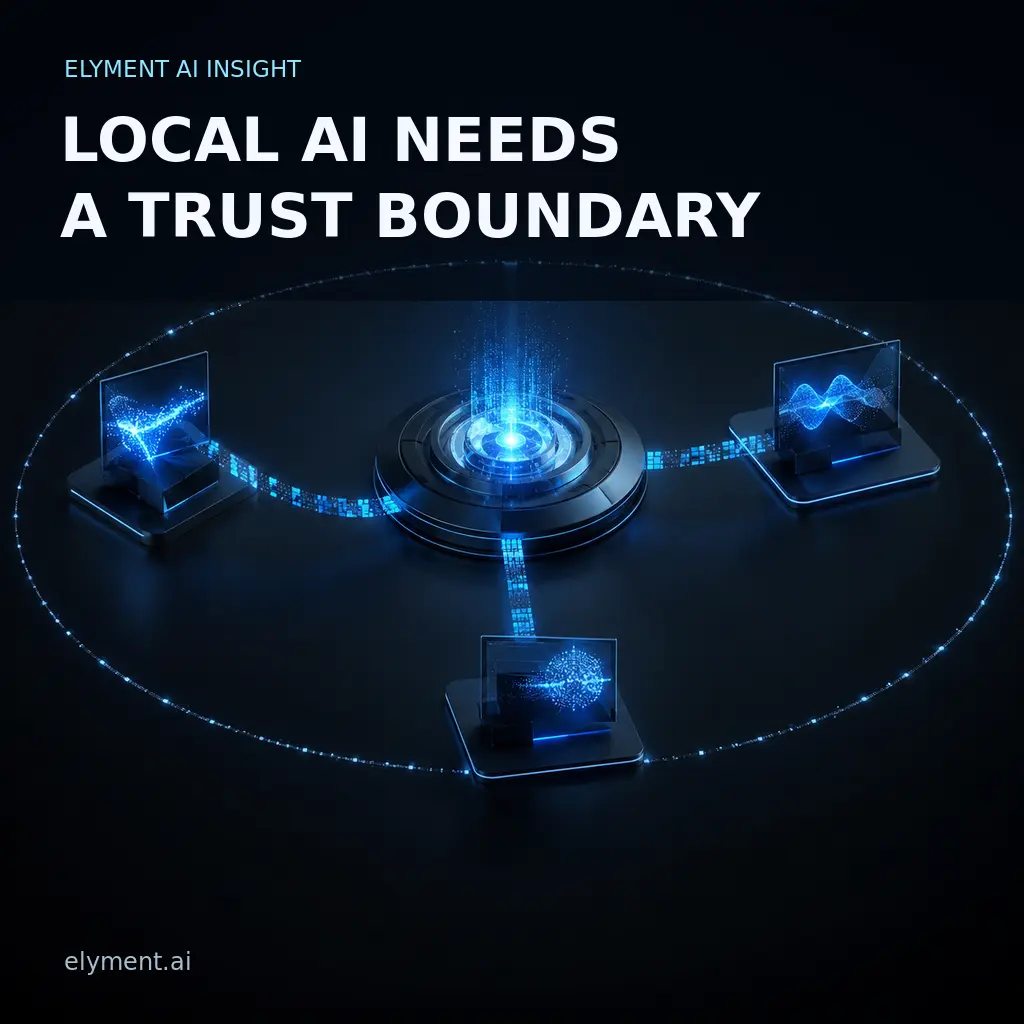
What NVIDIA PAIR actually does
PAIR presents Ollama-compatible and OpenAI-compatible proxy endpoints, then selects an eligible node according to engine availability, model availability and current workload. NVIDIA's documentation says the beta supports Windows 11, Linux and macOS nodes, including mixed operating systems, with Ollama and LM Studio as the supported inference engines at launch.
The important boundary is architectural. PAIR routes each independent request to one machine. It does not pool GPU memory, create a larger virtual GPU, shard a model across computers or divide one in-flight request between nodes. Its advantage is concurrency: several agent jobs can use different idle machines instead of queueing behind one busy device.
Local routing changes the trust boundary
NVIDIA positions PAIR as private local inference. Devices pair with a six-digit code, and node-to-node communication uses mutual TLS after pairing. That protects traffic between authenticated nodes, but it does not make every application, model, prompt or endpoint trustworthy. The project's own repository says prompts and responses are intended to remain local only when every configured client, model source, inference engine and node is local.
A company therefore needs an explicit network and data policy before connecting employee laptops, workstations or lab machines. Define which segments may discover nodes, who can join a cluster, which models may be downloaded, where logs are stored and which data classes may enter prompts. Treat a personal or shared network as untrusted until the architecture has been reviewed and tested.
The beta is not an enterprise service level
The open-source repository lists community support as best-effort and says maintainers do not guarantee a response or resolution time. That matters if PAIR becomes part of a customer workflow or overnight automation. Operators still need monitoring, version control, restart procedures, capacity limits and a fallback when a node, engine or model disappears.
Hardware breadth also needs careful interpretation. NVIDIA lists GeForce RTX 20 Series and newer, RTX PRO, DGX Spark and Apple M4 or newer among validated configurations. Mixed hardware can expand capacity, but it can also create uneven latency, memory limits, driver requirements and model availability. A successful demo on three machines is not evidence that an unmanaged device fleet will behave predictably.
Use a five-part local AI pilot gate
Before adopting PAIR for business work, require five checks:
- Workload fit: use concurrent, independent requests; do not expect one oversized model to span several devices.
- Trust boundary: isolate the network, approve participating nodes and test certificate, discovery and removal behaviour.
- Model control: pin approved models and engines, verify provenance and prevent uncontrolled downloads or updates.
- Operational proof: measure completed jobs, queue time, latency, failures, node churn, energy and support effort against one machine and cloud inference.
- Recovery: confirm workloads stop safely or reroute when a device sleeps, leaves the network or loses its model or engine.
What business leaders should do next
Start with a small, isolated cluster of company-managed devices and a non-sensitive, parallel workload such as document classification or test generation. Freeze the model and engine versions, record a single-machine baseline and run failure tests before adding real business data. Keep cloud or dedicated-server capacity available until local routing proves reliable and economical.
ELYMENT AI's private deployment analysis explains the operating burden that moves in-house, our hardware placement framework helps decide what should run at the edge or in the data centre, and the agent security guide shows how to test control boundaries. ELYMENT AI can help turn local AI experiments into governed workflows with evidence, ownership and a clear rollback path.
Sources
- NVIDIA: Local AI announcements at IFA 2026 (2026-09-03) - Primary launch announcement covering the PAIR beta, local-agent integrations, supported local inference tools and release timing.
- NVIDIA: Personal AI Router product page (2026-09-03) - Primary product information covering validated hardware, operating systems, local-network positioning and launch support for Ollama and LM Studio.
- NVIDIA: Personal AI Router repository (2026-09-03) - Primary open-source documentation defining request routing, privacy conditions, architecture limits, support status and deployment requirements.
- The Verge: NVIDIA launches PAIR for local AI inference (2026-09-03) - Independent reporting on PAIR's routing behaviour, compatible devices, pairing controls, mutual TLS and intended multi-device use.
Continue learning
Frequently asked questions
What is NVIDIA PAIR?
NVIDIA Personal AI Router is open-source beta software released on 3 September 2026 that routes local inference requests across compatible computers on the same network.
Does PAIR combine GPU memory across computers?
No. PAIR sends each independent request to one eligible node; it does not pool GPU memory, shard one model or split an in-flight request across machines.
Is PAIR ready for enterprise production?
It should be treated as a pilot technology. Businesses need their own network controls, model governance, monitoring, recovery, support and cost evidence before production use.