News analysis · Published
Reimagine Robotics: Why Frontline Workers May Become Robot Trainers
By the ELYMENT AI editorial team · Free to read
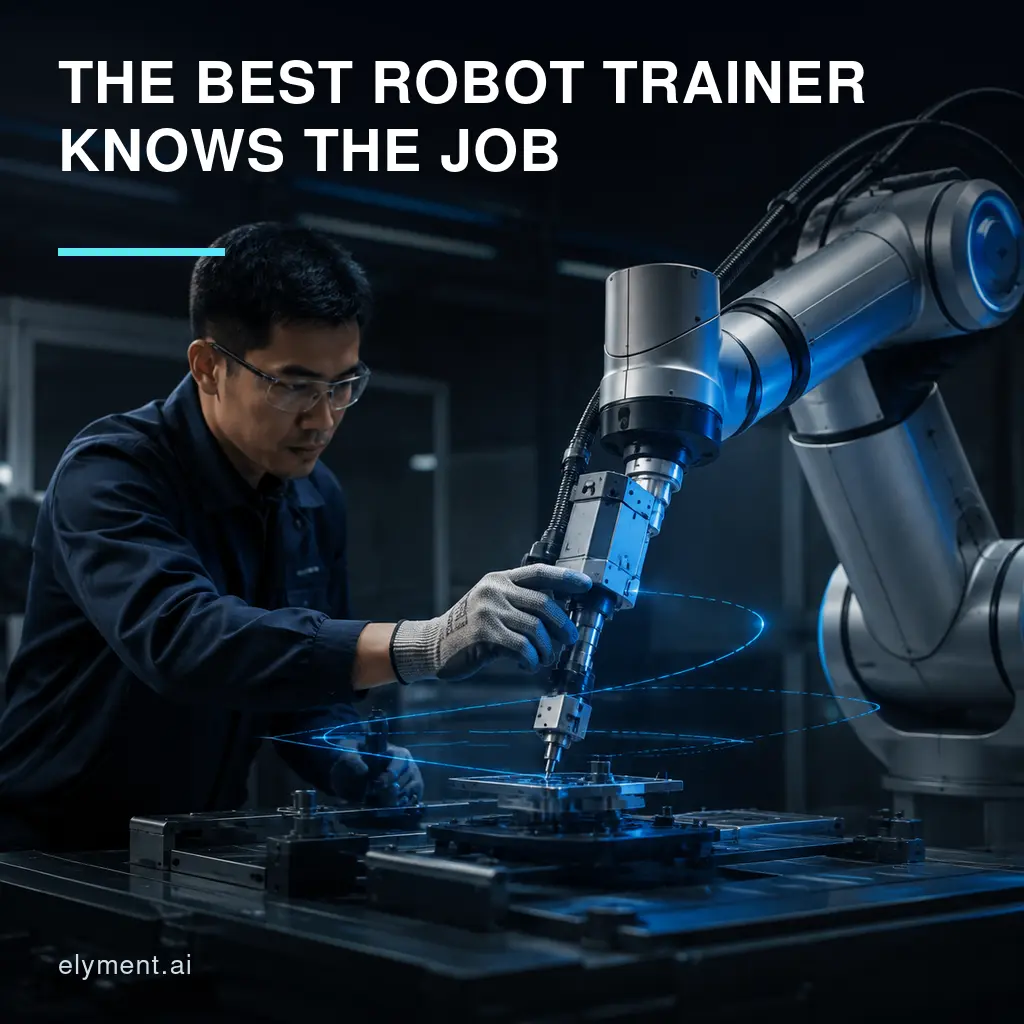
Reimagine Robotics is testing an industrial automation model in which factory workers teach robots by demonstration, observe the attempt and correct mistakes directly. Business Insider reported on 29 August 2026 that the London-and-Sydney startup wants customers to become robot trainers, extending a platform it unveiled on 3 August. The commercial opportunity is not simply faster programming. It is a shorter learning loop between process experts and machines. Businesses should test whether that loop improves safe task adaptation, uptime and accepted output before expanding a deployment.
What Reimagine Robotics has disclosed
Reimagine Robotics emerged from stealth on 3 August 2026. The company was founded in April 2025 by Jonathan Scholz, Oleg Sushkov, Akhil Raju and Misha Denil, former members of Google DeepMind's Applied Robotics team, and has headquarters in London and Sydney. Its stated approach lets workers show a robot a task, watch it perform and correct it on the spot instead of calling a specialist programmer whenever the process changes.
The company says its robots are already being tested in advanced manufacturing and electronics disassembly. In one deployment, robots tended 3D printers overnight and the customer's staff later taught additional washing, curing and drying steps. In another, a three-robot cell helped dismantle hard drives for materials recovery. Reimagine says the latter project reduced the time to prototype and test a new robot behaviour from about one day to around ten minutes. That is a company-reported result from a specific deployment, not an independently reproduced industry benchmark.
Why worker-led training changes the deployment model
Traditional industrial automation is strongest when a task is stable, structured and valuable enough to justify engineering and integration. High-mix work is harder: product dimensions, tools, materials and operating conditions change, while the people closest to the process may have to wait for an external robotics team to update the system.
Worker-led teaching moves part of that adaptation cycle onto the factory floor. The operator contributes practical knowledge about acceptable variation, failure signals and recovery. The robot contributes repeatability and the ability to take on physical work. If the interface is genuinely usable, the business may test more use cases and correct them faster. If it is unreliable or difficult to govern, the same flexibility can multiply unsafe or inconsistent behaviours.
Build the operating model around frontline expertise
Treat robot teaching as a controlled operational role, not an informal feature. A practical deployment should define:
- Task boundary: the materials, tools, workspace and outcomes the robot is authorised to handle.
- Teacher authority: who may demonstrate, correct, approve or retire a learned behaviour.
- Safety controls: physical interlocks, speed and force limits, exclusion zones and an independently tested stop path.
- Evidence: demonstration versions, corrections, approvals, exceptions and changes to the learned policy.
- Escalation: conditions that return the task to a human or specialist engineer before production resumes.
Measure learning speed and production value separately
A ten-minute prototype is useful only if the resulting behaviour remains safe and productive. Track time from task selection to an approved production behaviour, then measure first-pass yield, interventions per cycle, unplanned stops, recovery time and output accepted without rework. Compare performance across product variants and shifts rather than relying on a polished demonstration.
Also measure the human system. Record how many authorised workers can teach the task successfully, how much training they need, whether corrections are reproducible and whether the deployment removes a genuine bottleneck. The economic case should include integration, supervision, downtime, maintenance and safety work, not only robot utilisation.
What business leaders should do next
Choose one bounded, reversible task with clear acceptance criteria and operators who understand it deeply. Run the robot beside the existing process, preserve every correction and require human approval before learned behaviour reaches production. Expand only when the evidence shows stable quality, safer work and a sustainable cost per accepted unit.
ELYMENT AI's analysis of Anthropic's Model Hardware Standard explains why model-controlled equipment still needs independent safety boundaries. Our humanoid-robot data guide shows why real-world learning data is scarce, while the Intel agentic hardware review connects workloads from rack to edge. ELYMENT AI can help operators turn those principles into a staged physical-AI evaluation with clear authority, evidence and stop conditions.
Sources
- Reimagine Robotics: Robots that learn on the job (2026-08-03) - Primary company source for the launch, founders, deployment examples, worker-led teaching model and reported prototype-time reduction.
- Business Insider: Turning customers into robot teachers (2026-08-29) - Independent interview covering the post-training strategy, customer role, deployment challenge and reported hard-drive recovery example.
- The Robot Report: Reimagine Robotics emerges from stealth (2026-08-03) - Independent robotics-industry reporting on the launch, team, target use cases and worker-trainable deployment approach.
Continue learning
Frequently asked questions
What does Reimagine Robotics do?
It is developing industrial robots that workers can teach by demonstrating a task, observing the attempt and correcting the robot directly as the process changes.
Can factory workers train robots without coding?
Reimagine Robotics says its platform is designed for direct worker instruction without specialist programming. Businesses should validate usability, safety and repeatability in their own environment.
Which metric matters most in a robot-teaching pilot?
Start with time to an approved production behaviour, then pair it with first-pass yield, human interventions, safety events, downtime and cost per accepted unit.